

Dollar Tumbles Most in 12 Weeks Following Dismal Employment Data
Key Takeaways
- The greenback is poised for its steepest weekly decline since the first week of April, shedding approximately 0.7% over five trading days
- Employment gains for June registered only 57,000, significantly undershooting the anticipated 110,000 figure
- Probability of a Federal Reserve rate increase in September plummeted from approximately 64% to a range of 35–52%
- The yen experienced a modest recovery after touching a four-decade weakness of 162.84 against the dollar
- Japanese officials signaled readiness to intervene in currency markets if circumstances warrant action
The greenback is on course for its most substantial weekly decline in almost a quarter as lackluster June employment figures dampened market enthusiasm for additional Federal Reserve monetary tightening.
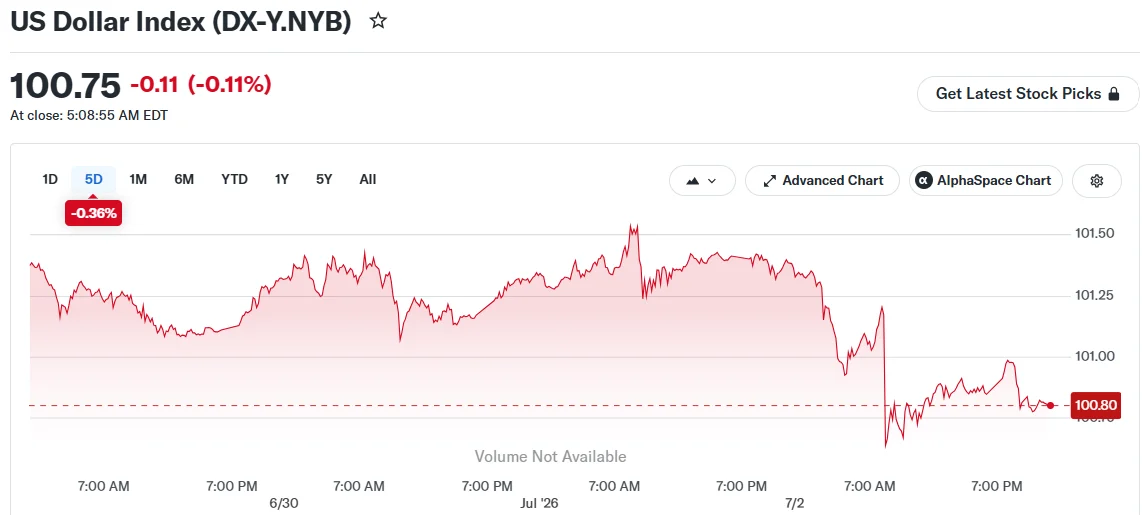 US Dollar Index (DX-Y.NYB)
June’s nonfarm payroll expansion registered a meager 57,000 positions. This figure landed well beneath the 110,000 consensus estimate among economic analysts. Previous months’ employment data also underwent downward revisions.
The proportion of Americans participating in the workforce declined to 61.5%, marking the weakest reading in over half a decade. Market participants swiftly recalibrated their projections regarding the central bank’s monetary policy trajectory.
Prior to the employment release, financial markets had assigned roughly a 64% probability to a September rate adjustment. Following the data, this expectation contracted to a bracket between 35% and 52%, based on analytics from CME FedWatch and LSEG platforms.
Benchmark U.S. government bond yields retreated in response. The two-year Treasury note yield, particularly responsive to interest rate projections, ended a three-session advance with a four basis-point contraction.
The dollar index, measuring the American currency against a collection of major trading partners’ currencies, declined roughly 0.3% to settle at 100.68 on Friday’s session. The weekly performance represents approximately a 0.7% drop, marking the most pronounced weekly retreat since the beginning of April.
Global Currency Movements
The European common currency advanced toward $1.1472, approaching a two-week peak, with a weekly appreciation of roughly 0.6%. Sterling strengthened to $1.3380, positioned for a 1.2% weekly advance — its most impressive performance in nearly ninety days.
The Australian currency climbed to $0.6935, appearing set to break a four-week sequence of losses. New Zealand’s dollar registered approximately 1.2% gains across the week.
Karl Steiner, who leads analytical operations at SEB, noted the disappointing figures aligned with his organization’s forecast that the dollar would eventually reverse direction. He indicated additional weakness could materialize.
Yen Situation Under Scrutiny
The Japanese yen found some temporary stability this week, strengthening past the 161 threshold versus the dollar following Thursday’s descent to a 40-year nadir of 162.84.
Japanese Finance Minister Satsuki Katayama stated Friday that Tokyo maintains consistent communication with Washington regarding exchange rate matters and remains prepared to take measures. Chief Cabinet Secretary Minoru Kihara emphasized that authorities were tracking market developments with heightened attention.
Market observers are now anticipating potential official intervention, particularly during subdued holiday liquidity conditions with American exchanges shuttered for Independence Day observances.
Tony Sycamore, an analyst with IG, suggested that 162.83 appears to represent a near-term ceiling for the dollar-yen exchange rate. He indicated future direction will primarily hinge on forthcoming American economic releases and dynamics within Japanese sovereign debt markets.
The post Dollar Tumbles Most in 12 Weeks Following Dismal Employment Data appeared first on Blockonomi.


You May Also Like

DC insider: Trump will cause some of you to die from the heat

XRP MVRV Hits All-Time Low: Relief Rally Setup Emerges as Traders Stay Deep Underwater


