

Aave Adjusts USDT Interest Rate Curve: Why Does Tighter Stablecoin Liquidity Push Borrowing Costs Higher Earlier?
Overview
Aave adjusted the USDT variable borrowing interest rate model on its V3 Ethereum Core market on October 21, 2026, lowering the optimal utilization threshold from 94% to 92%. The change followed a recommendation from risk service provider LlamaRisk and was executed at Ethereum block 26,241,799. The base rate and the two principal interest rate slopes remained unchanged, meaning the update altered when borrowing costs begin accelerating rather than introducing a uniform rate increase.
The Aave USDT Interest Rate adjustment addresses the relationship between stablecoin borrowing demand and available reserve liquidity. As a larger portion of supplied USDT is borrowed, less remains immediately available for withdrawals. Aave's interest rate model responds by making additional borrowing increasingly expensive as utilization approaches the upper end of the reserve's capacity.
Under the new parameters, a reserve operating at 94% utilization would have a modeled variable borrowing APR of 7.0%, compared with 4.5% previously. At the 85.6% utilization observed in LlamaRisk's October 20 assessment, the modeled increase was much smaller, from approximately 4.10% to 4.19%.
The adjustment therefore concentrates its strongest effect near liquidity scarcity. It does not create additional USDT, reduce the borrowing limit by two percentage points, or guarantee withdrawal availability. Instead, Aave is changing the economic incentives surrounding scarce stablecoin liquidity, attempting to preserve more withdrawal headroom before borrowing demand pushes the reserve toward exhaustion.
Key Takeaways
- Aave reduced the USDT optimal utilization threshold from 94% to 92% on Ethereum V3 Core on October 21, 2026.
- The base borrow rate remains 0%, with Slope 1 at 4.5% and Slope 2 at 10%.
- At 94% utilization, modeled variable borrowing APR increases from 4.5% to 7.0%.
- The revised threshold creates approximately 57.8 million USDT of additional modeled liquidity buffer at the same reference supply, without adding new funds.
- Borrowing remains possible above 92% when other conditions permit, but its marginal cost increases more sharply.
Aave USDT Interest Rate Curve Changes at 92% Utilization
Aave's adjustment affects a specific reserve and interest rate strategy rather than every USDT market on the protocol. The change applies to USDT on Aave V3 Ethereum Core, where the optimal utilization threshold was reduced from 94% to 92%. The other major interest rate parameters remained unchanged: a 0% base rate, a 4.5% first slope, and a 10% second slope. The new configuration changes the utilization level at which borrowing costs begin rising at a steeper rate.
The economic reasoning is straightforward. Aave allows suppliers to deposit stablecoins that borrowers can access by posting qualifying collateral. The share of supplied assets currently borrowed is measured through utilization. When utilization is relatively low, lenders have more unborrowed liquidity available for withdrawal. As utilization increases, a larger proportion of supplied capital is committed to outstanding loans. At very high utilization, the reserve becomes more sensitive to withdrawals, repayments, and sudden changes in demand.
The variable interest rate curve attempts to balance these competing interests by increasing borrowing costs as available liquidity declines. Lowering the optimal utilization threshold means borrowers encounter the steeper portion of the curve earlier, strengthening the incentive to repay debt or avoid additional borrowing when the reserve approaches liquidity stress.
Aave USDT Interest Rate Parameters: Before and After
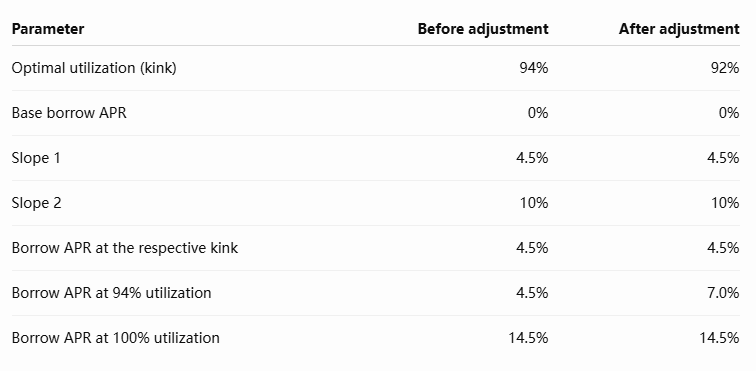
The table shows that the adjustment does not raise the theoretical maximum rate under the model. Both configurations reach 14.5% at full utilization. Instead, the rate increases more quickly in the high-utilization region between the revised 92% threshold and full utilization. This is a targeted repricing of scarce liquidity rather than a uniform increase in the cost of every outstanding loan.
How Does Aave's Interest Rate Kink Work?
Aave uses a two-slope variable borrowing rate model. Below the optimal utilization threshold, borrowing rates increase gradually with utilization. Above that threshold, the rate rises more steeply as the amount of immediately available liquidity decreases.
For the USDT parameters in this adjustment, the model can be expressed as:
Below the optimal threshold:
Borrow APR = 4.5% × (Utilization ÷ Optimal Utilization)
Above the optimal threshold:
Borrow APR = 4.5% + 10% × [(Utilization − Optimal Utilization) ÷ (100% − Optimal Utilization)]
The revised model keeps both slopes unchanged but moves the point at which the second portion begins from 94% to 92%.
Aave USDT Borrow APR: Old vs. New Curve
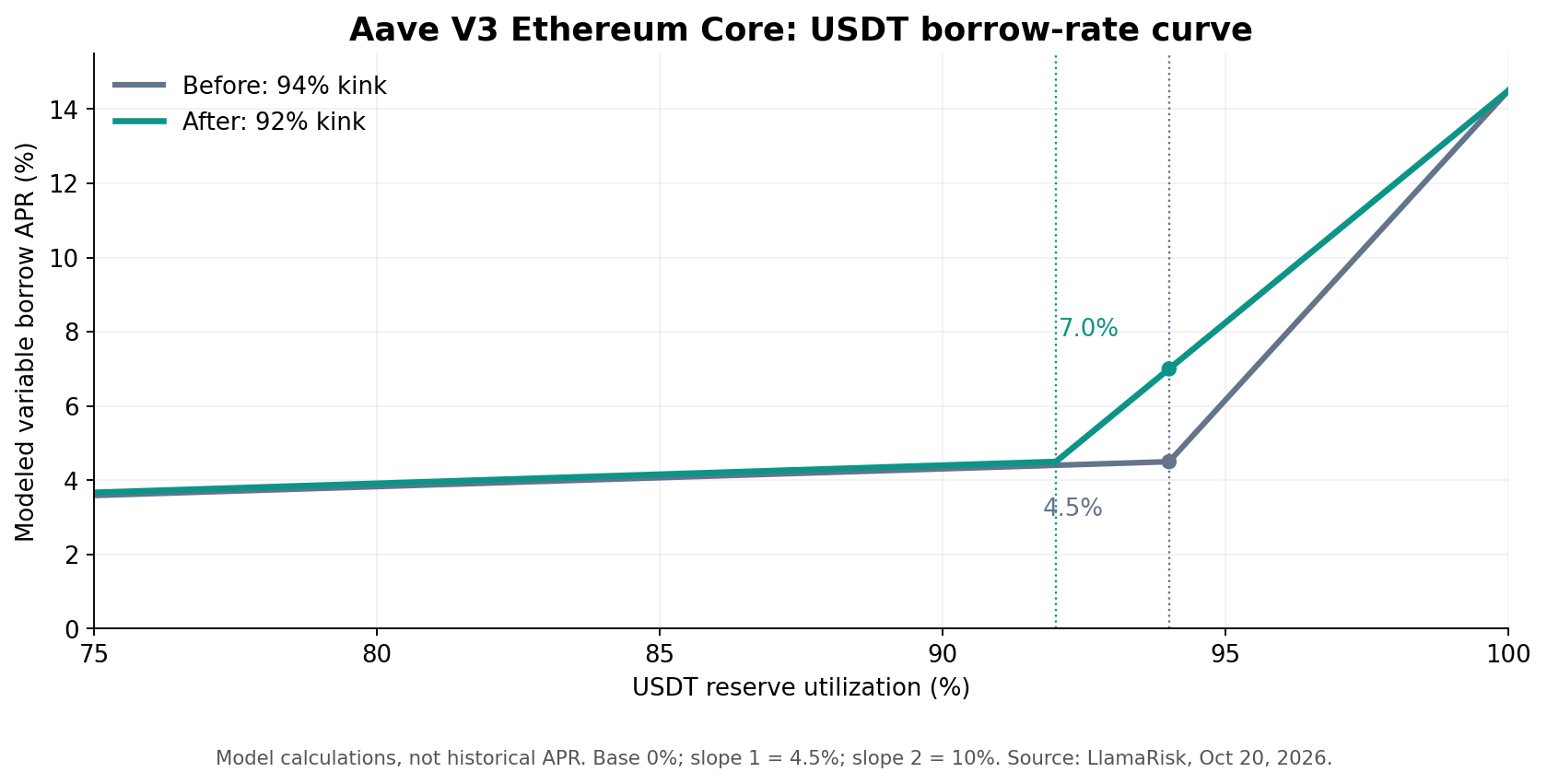
Figure 1. Calculated variable borrowing APR under the 94% and 92% optimal utilization configurations. The curves are derived from the disclosed interest rate model parameters and are not historical observed APR data. Source: Aave Governance and LlamaRisk, October 2026.
The most pronounced difference occurs near the former threshold. At 94% utilization, the old model produces a borrowing rate of 4.5%, while the revised model produces 7.0%. At 85.6% utilization, however, the difference is only about nine basis points.
This illustrates why the adjustment should not be described as a sudden increase in borrowing rates across the entire market. Its effect depends on how close the reserve is to high utilization, where the availability of liquidity becomes more important.
Why Borrowing Costs Rise Earlier When Liquidity Tightens
The purpose of lowering the kink is to influence borrowing behavior before a reserve becomes almost fully utilized. When borrowing costs remain relatively low near the upper end of available liquidity, users may continue taking loans even as withdrawal headroom becomes increasingly limited. This can create conditions in which suppliers have difficulty withdrawing substantial amounts without waiting for new deposits or loan repayments.
A steeper borrowing rate introduces a financial cost to consuming scarce liquidity. Some borrowers may repay their loans when financing costs exceed the returns generated by their strategies. Others may avoid opening additional positions, while higher supplier yields may attract new deposits. These responses can potentially improve available liquidity, but none is guaranteed. Borrowers may accept higher interest rates, suppliers may withdraw funds, and broader market conditions may offset the intended incentives.
Aave's decision therefore reflects a particular approach to liquidity management: instead of prohibiting borrowing at the optimal utilization threshold, the protocol makes borrowing more expensive beyond it.
This distinction gives the reserve flexibility to accommodate temporary increases in loan demand while using prices to discourage prolonged periods of excessive utilization. The mechanism can reduce the attractiveness of further borrowing, but it cannot force existing borrowers to repay immediately or create new liquidity on demand.
Why a 57.8 Million USDT Buffer Is Not New Liquidity
LlamaRisk's October 20 assessment provides a numerical illustration of the change. At the time, the reserve had approximately 2,892.2 million USDT in supplied assets and 2,475.1 million USDT in outstanding borrowing, producing utilization of about 85.6%. Approximately 417 million USDT remained unborrowed.
Using the same supplied balance, LlamaRisk calculated the amount of unborrowed liquidity that would remain if utilization reached the old and new optimal thresholds. At 94% utilization, the modeled buffer was approximately 173.5 million USDT. At 92%, it increased to approximately 231.4 million USDT.
Liquidity measureOld 94% kinkNew 92% kinkReference supplied USDT2,892.2M2,892.2MOptimal utilization94%92%Modeled unborrowed liquidity at the kink173.5M231.4MAdditional modeled buffer—Approximately 57.8MActual idle liquidity in the reference snapshotApproximately 417.0MApproximately 417.0M
The additional 57.8 million USDT is the difference between two hypothetical liquidity buffers calculated from the same supplied balance. It is not a new deposit, protocol reserve injection, or confirmed increase in immediately withdrawable funds.
Under the new configuration, the steeper interest rate regime begins when more USDT remains unborrowed. Whether this leads to a consistently larger available balance depends on actual borrower repayments, new deposits, withdrawals, and changes in utilization after implementation.
Who Gains and Who Pays Under the New Curve?
Borrowers experience the most direct effect when utilization rises toward the revised threshold. Users maintaining variable-rate USDT debt face higher financing costs at a given high utilization level than they would under the previous configuration. This matters for leveraged strategies that borrow stablecoins to purchase other assets, manage collateral, or generate returns through interest-rate differences. A position that remains economically attractive with a 4.5% borrowing cost may become less viable when its financing cost approaches 7% or more.
Suppliers may receive higher variable returns when borrowing demand remains strong, but those returns depend on utilization, borrowing rates, and the protocol's reserve factor. Higher supplier yields do not necessarily mean the reserve has become less risky or easier to exit. In fact, elevated yields can coincide with reduced withdrawal availability when a large proportion of deposits remains borrowed.
This relationship is a broader characteristic of variable-rate stablecoin lending. MEXC's explanation of factors affecting variable USDT interest rates provides additional background on how borrowing demand and available liquidity influence yields. However, Aave's specific rates are determined by its own onchain interest rate parameters rather than by the yield methodology of other platforms.
The adjustment therefore creates different incentives for different participants. Borrowers may reduce debt, suppliers may respond to higher yields, and the reserve may experience changes in utilization. No outcome is automatic, and actual market behavior remains the decisive variable.
FAQ
Why did Aave lower USDT optimal utilization from 94% to 92%?
Aave lowered the threshold to make borrowing costs increase more aggressively before the reserve reaches extremely high utilization. The intended effect is to preserve additional withdrawal headroom through economic incentives, not to increase the reserve's actual USDT balance directly.
Does a lower utilization kink increase USDT borrowing costs for everyone?
The revised model generally produces higher variable borrowing rates at the same positive utilization, but the size of the difference varies. The increase is relatively small below the new threshold and more pronounced near the former 94% kink. Actual rates continue to change with reserve utilization.
Can users still borrow USDT above 92% utilization?
Yes. The 92% threshold determines where the interest rate curve becomes steeper; it is not an absolute borrowing prohibition. Additional borrowing remains possible when available liquidity, collateral requirements, and other reserve restrictions permit, but its financing cost becomes increasingly expensive.
Aave Is Repricing Liquidity Scarcity Before the Pool Runs Dry
Aave's October 21 change demonstrates how a small adjustment to an interest rate parameter can significantly affect borrowing incentives under specific market conditions. Reducing optimal USDT utilization from 94% to 92% leaves the underlying slope parameters unchanged while bringing the steeper borrowing-rate segment forward. The effect is concentrated near liquidity scarcity, where maintaining adequate funds for supplier withdrawals becomes increasingly important.
The Aave USDT Interest Rate adjustment does not represent a reduction in outstanding loans or the creation of additional stablecoin reserves. Instead, it changes the financial incentives facing borrowers who consume liquidity when utilization becomes elevated. The modeled increase in the optimal liquidity buffer illustrates the intended risk-management effect, but whether that buffer is maintained depends on actual deposits, withdrawals, borrowing, and repayments.
Future evaluation should focus on sustained utilization around the new 92% threshold, available USDT liquidity, variable borrowing costs, supplier yields, and the reserve's behavior during periods of elevated demand. These indicators can reveal whether the revised curve improves withdrawal flexibility without unnecessarily restricting economically productive lending.
The longer-term significance lies in the role of automated pricing within DeFi financial risk management. Protocols must continuously balance demand for leverage with the need to maintain liquidity, and the interest rate model is one of the principal mechanisms through which that balance is achieved.
Aave is not creating liquidity through its rate adjustment; it is making scarce liquidity more expensive to consume at an earlier stage. Whether that decision improves reserve resilience will depend on how market participants respond to the revised incentives.
Sources
MEXC internal link used:
https://www.mexc.com/learn/article/why-does-usdt-apr-change-7-factors-that-affect-crypto-earn-rates/1
Aave Governance — Risk Stewards: Cap Reductions and USDT IRM Change on Aave V3, October 2026:
https://governance.aave.com/t/risk-stewards-cap-reductions-and-usdt-irm-change-on-aave-v3-2026-10-19/25885
CryptoSlate — Aave Changes USDT Borrowing Rules and Loan Costs Suddenly Jump:
https://cryptoslate.com/aave-changes-usdt-borrowing-rules-and-loan-costs-suddenly-jump/
Risk Disclaimer: This article is for reference only and does not constitute investment advice. The cryptocurrency market is highly volatile. Please make decisions cautiously based on your individual circumstances.


评论
仅可选择预设评论和表情符号