Key Takeaways
BitMart announced on Sunday, July 26, 2026 that it will wind down its trading platform after nine years, with all trading ending August 26 and full closure on January 31, 2027. Its BMX token crashed nearly 60% within hours.
The move came just three days after BitMEX, the exchange that invented the perpetual swap, said it will shut down on September 23 after an 11 year run, sending its BMEX token down roughly 90%.
BitMart is the third centralized exchange to announce a closure this month, following AscendEX on July 1, and analysts count more than 30 crypto project shutdowns in 2026 across exchanges, layer 1s, layer 2s and DeFi protocols.
The common thread is a squeeze on mid tier platforms: bear market volumes, liquidity concentrating on the largest venues, and decentralized perpetual exchanges now holding around 13.5% of total open interest.
Users on affected platforms should withdraw early, complete any required identity checks, close open futures positions before forced settlement, and stay alert for phishing attempts that spike around exchange closures.
BitMart Calls Time After Nine Years
BitMart told users on July 26 that it has begun an orderly wind down of its trading platform after evaluating its operating conditions, market environment and future strategic direction. The timeline is tight. New registrations, deposits and new trading orders stopped at 01:30 UTC the same day, futures accounts moved to reduce only mode, and copy trading, grid bots, API access and other automated services are being phased out. All spot and futures trading ends on August 26 at 01:00 UTC, and the platform formally ceases operations on January 31, 2027. Withdrawals remain open throughout, though the exchange warned that additional identity and security checks could slow processing as users rush for the exit.
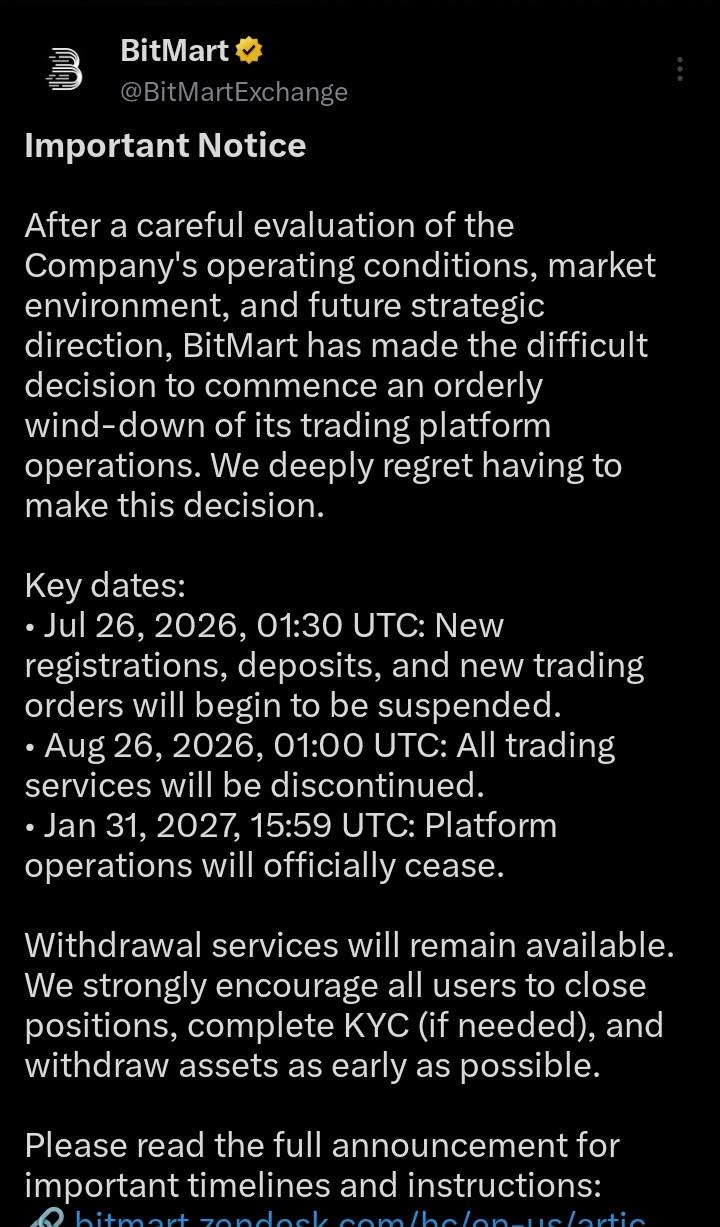
The announcement blindsided parts of its own leadership: former BitMart Global CEO Nenter Chow said he was not involved in the decision and learned of it publicly. It also came just nine days after BitMart published an upbeat first half report highlighting rapid asset management growth, a new prediction market product, and a fresh Australian financial services license. The market reaction was brutal, with the exchange's BMX token dropping as much as 60% in 24 hours, extending a yearlong slide of roughly 70%. Notably, there is no mention of insolvency, a hack or enforcement action anywhere in the notice; this reads like a business whose unit economics stopped working.
BitMEX: The End of an Era
Three days earlier, BitMEX delivered an even more symbolic exit. The derivatives pioneer co-founded by Arthur Hayes, Ben Delo and Samuel Reed in 2014 invented the perpetual swap and popularized 100x leverage, products that came to define crypto trading. Its owner, HDR Global Trading Limited, said a strategic review led to the decision to cease operations on September 23 at 04:00 UTC, while stressing that user assets remain safe and that the platform never lost customer funds to a hack in more than 11 years.
The backstory is heavier. BitMEX paid more than $200 million in combined US regulatory penalties over the years after prosecutors accused it of operating without adequate anti money laundering and know your customer programs between 2015 and 2020. Its founders pleaded guilty in 2022 and were pardoned by President Trump last year. Users now have until the September deadline to close positions and withdraw; those who leave assets behind face a monthly maintenance fee of $50 or an annualized 1% levy. The BMEX token collapsed about 90% on the news to a market value near $497,000.
A Shakeout, Not a Coincidence
BitMart is the third centralized exchange to announce a shutdown in a single month, after AscendEX closed on July 1 and BitMEX followed on July 23. Zoom out and the pattern widens: analysts tracking the space count more than 30 crypto project shutdowns in 2026, spanning exchanges, layer 1 and layer 2 networks and DeFi protocols. Simon Dedic, founder of Moonrock Capital, argues the mid tier exchange model carries a "fatal flaw" because it depends on a constant inflow of new users, and when that inflow dries up the business fails. In his view, the closures are a sign of markets healing rather than breaking, as capital and users consolidate onto sustainable platforms.
The macro backdrop explains the timing. Bitcoin fell roughly 33% in the first half of 2026 and
Ethereum about 50%, spot ETFs saw record outflows in June, and trading volumes cooled across the top centralized venues. At the same time, liquidity has concentrated into a handful of the largest exchanges, while onchain perpetual platforms led by Hyperliquid have grown to roughly 13.5% of total open interest, squeezing mid sized centralized players from both directions.
The Exchange Token Lesson
The instant collapses of BMEX and BMX carry a structural warning that echoes FTT during the FTX bankruptcy in 2022: an exchange token is not an independent financial asset, it is leveraged exposure to the operational continuity of one platform. When the platform announces its end, the token's reason to exist ends with it. Traders holding
exchange tokens should size positions with that concentration risk in mind.
How to Protect Your Funds During an Exchange Shutdown
If you have assets on a closing platform, act early rather than at the deadline. Withdrawal queues, extra compliance checks and customer support backlogs all worsen as cutoffs approach. Complete any outstanding identity verification now, since unverified accounts often face the longest delays. Close open futures positions yourself before the exchange force settles them under its own rules, cancel standing orders, and redeem any staked, lent or earn product balances, which often have separate timelines. Export your trade history and statements for tax records before the platform goes dark, and only use withdrawal links from the exchange's official site or app: phishing campaigns reliably spike around shutdowns, impersonating support teams and "asset recovery" services.
What It Means for Traders on MEXC
Consolidation is pushing users toward venues with deep liquidity, long operating track records and broad asset coverage, and that flight to quality is likely to continue through this cycle. For traders relocating from closing platforms, MEXC supports deposits across major networks and offers extensive
spot and
futures markets to migrate positions into. Whichever venue you choose, the era's core lessons apply everywhere: diversify where you hold assets, consider
self custody for long term holdings, and treat any platform's native token as a bet on that platform itself.
Disclaimer: This content is for educational and reference purposes only and does not constitute any investment advice. Digital asset investments carry high risk. Please evaluate carefully and assume full responsibility for your own decisions.