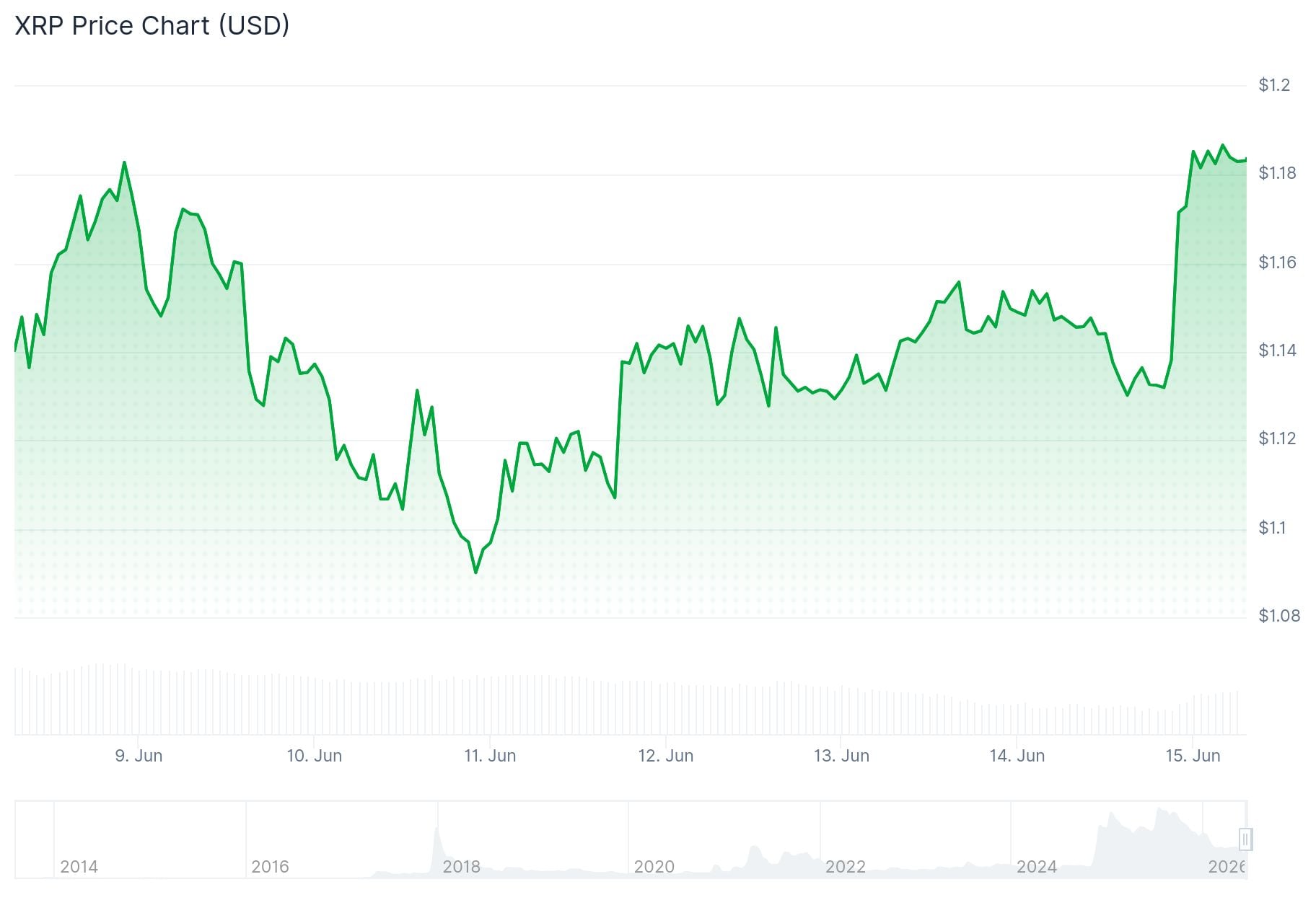
After a brutal stretch that knocked Bitcoin from its $126,000 record down to roughly $59,000, one of the most closely watched voices in traditional finance has called the bottom. On June 12, 2026, Standard Chartered's global head of digital assets research, Geoffrey Kendrick, told clients: "Winter is over. Welcome back to crypto Spring." His view is that Bitcoin's
$59,000 low printed on June 5 is the definitive cycle floor, and that
BTC is on track for $100,000 by year-end.
It's a bold call at a fragile moment. Bitcoin is still roughly 50% below its peak, the Crypto Fear & Greed Index sits in "Extreme Fear," and spot ETFs have bled over $2 billion this month. But the early-June crash also looked a lot like capitulation forced liquidations, washed-out leverage, and panic selling. So is the worst really behind us? Here's the case for a “crypto spring,” the risks that could derail it, and how to position on MEXC either way.
Key Takeaways
Standard Chartered's Geoffrey Kendrick declared on June 12 that "crypto winter is over," calling Bitcoin's ~$59,000 low on June 5 the definitive cycle bottom.
That low was a ~53% drop from Bitcoin's $126,000 all-time high (Oct 6, 2025), painful, but milder than the 77% and 84% drawdowns of past cycles.
The bank reaffirmed year-end targets of $100,000 for BTC (~70% upside) and $4,000 for ETH, and expects Ethereum to outperform Bitcoin in the rebound.
Kendrick blames the selloff on temporary factors — heavy spot-ETF selling (partly to fund the SpaceX IPO) and macro stress — not a structural breakdown.
Three signals he's watching to confirm the bottom: renewed ETF inflows, corporate-treasury buying, and lower oil prices (tied to a possible US–Iran peace deal).
BTC has since rebounded toward ~$64,000 and ETH toward ~$1,680; not everyone agrees the bottom is in, so volatility remains high.
The Crash: How Bitcoin Fell 53%
Bitcoin peaked at $126,000 on October 6, 2025, then ground lower into 2026 before capitulating in early June. It touched roughly $59,108–$59,375 on June 5 — about a 53% decline from the high — as a broad rout wiped hundreds of billions from the market and forced liquidations cascaded across leveraged positions (privacy coin Zcash alone saw more than $116 million in liquidations). The Fear & Greed Index sank into “Extreme Fear.” By Bitcoin's own history, though, the move is almost routine: the 2017–18 bear market fell 84% and the 2021–22 cycle around 77%.
Standard Chartered's "Crypto Spring" Thesis
In his June 12 note, Kendrick wrote that he believes the cycle low is in at $59,000 and reaffirmed Standard Chartered's year-end 2026 targets of $100,000 for Bitcoin and $4,000 for Ethereum (trimmed earlier this year from $150,000 and $7,500). The bank's longer-term 2030 forecasts are unchanged at $500,000 for BTC, $40,000 for ETH, $2,000 for
Solana, and $28 for XRP. Crucially, Kendrick frames the selloff as driven by temporary forces rather than a structural breakdown: heavy selling of US spot Bitcoin ETFs — partly to free up cash for the SpaceX IPO, which has now begun — alongside elevated oil and Treasury yields. He also expects
Ethereum to outperform Bitcoin in the recovery, since ETH needs roughly a 2.5x move to hit $4,000 versus about 1.57x for BTC to reach $100,000.
Three Signals That Would Confirm the Bottom
Renewed ETF inflows — June has seen over $2 billion of net outflows, but June 12 flipped to a positive $85.85 million; Kendrick wants to see that shift sustained.
Corporate-treasury buying — he has called on Strategy (MSTR), which holds 845,256 BTC and trades around 18% below the value of its Bitcoin, and its imitators to step up accumulation.
Lower oil prices — a potential US–Iran peace deal could cap oil, easing inflation and Treasury yields and giving central banks more room to cut rates.
The Bear Case: Why It Might Not Be the Bottom
Not everyone shares Kendrick's confidence. His thesis rests on catalysts that are not yet confirmed: ETF flows could turn negative again, the US–Iran peace deal may not materialize, and global monetary policy remains unsettled — the Federal Reserve meets June 16–17 with a hawkish lean. Some traders even read a legacy bank leaning this far out on the risk curve as a contrarian warning. Bottom calls have failed before, and a 53% drawdown does not guarantee the selling is finished. The prudent approach is to
manage volatility with risk controls rather than assume the floor will hold.
Conclusion
A 53% drawdown is painful, but by Bitcoin's standards it's almost ordinary — and a major bank publicly calling the bottom and sticking to a $100,000 target is a notable vote of confidence. The thesis is not guaranteed: it depends on ETF inflows returning, treasuries buying, and macro stress easing, none of which are locked in. The next few weeks of flow data and the Fed's June meeting should reveal whether this is the start of a genuine "crypto spring"— or another false dawn.
Disclaimer: This content is for educational and reference purposes only and does not constitute any investment advice. Digital asset investments carry high risk. Please evaluate carefully and assume full responsibility for your own decisions.