Irys, a layer-1 blockchain listed on major exchanges including Coinbase, is under scrutiny after a single entity captured roughly 20% of its airdrop allocation. On November 28, blockchain analytics firm Bubblemaps said it identified about 900 wallets involved in the process. IRYS Slides After 900 Linked Wallets Take $4 Million in Airdrop Tokens According to the firm, these addresses showed no prior on-chain activity. It described the pattern as consistent with coordinated preparation rather than organic network participation. Following the distribution, the cluster network began consolidating the assets. Data shows that roughly 500 of the identified wallets transferred their IRYS allocations to intermediary addresses before routing the funds to Bitget, a centralized exchange. IRYS Token Address Clusters. Source: BubbleMaps The flow of tokens, valued at approximately $4 million, indicates a likely preparation to liquidate the position. Such a move could introduce significant sell-side pressure on the asset’s order book. IRYS price has come under pressure following the disclosures. The token has declined 16% over the past 24 hours and is trading near $0.032 as of press time. Bubblemaps noted that it found no on-chain evidence linking the IRYS team to the wallet cluster. Irys markets itself as an “on-chain AWS” designed for data storage and smart-contract execution. The protocol has raised more than $13 million from venture capital investors and listed its token this week on major exchanges, including Binance and Coinbase. Crypto Needs Stronger Sybil Protection The episode highlights a structural challenge facing crypto projects that rely on airdrops to expand ownership. Indeed, Irys allocated 8% of its total supply to the event. The goal was to distribute tokens to early users and help decentralize the network. Instead, the concentration of tokens in a single cluster shows how airdrops remain vulnerable to actors using large batches of script-generated wallets to capture outsized allocations. When one entity controls 20% of the initial circulating float, market observers say the result is heightened centralization risk and distorted price discovery. Meanwhile, incidents like this point to broader limitations in token distribution practices across permissionless ecosystems. These environments have minimal identity checks and unrestricted network access. This IRYS episode shows how difficult it is to prevent coordinated airdrop capture without stronger filtering, better identity heuristics, or more robust pre-distribution reviews. Without those safeguards, early liquidity events can disproportionately benefit short-term actors. That dynamic can weaken outcomes for long-term holders and overall network stability.Irys, a layer-1 blockchain listed on major exchanges including Coinbase, is under scrutiny after a single entity captured roughly 20% of its airdrop allocation. On November 28, blockchain analytics firm Bubblemaps said it identified about 900 wallets involved in the process. IRYS Slides After 900 Linked Wallets Take $4 Million in Airdrop Tokens According to the firm, these addresses showed no prior on-chain activity. It described the pattern as consistent with coordinated preparation rather than organic network participation. Following the distribution, the cluster network began consolidating the assets. Data shows that roughly 500 of the identified wallets transferred their IRYS allocations to intermediary addresses before routing the funds to Bitget, a centralized exchange. IRYS Token Address Clusters. Source: BubbleMaps The flow of tokens, valued at approximately $4 million, indicates a likely preparation to liquidate the position. Such a move could introduce significant sell-side pressure on the asset’s order book. IRYS price has come under pressure following the disclosures. The token has declined 16% over the past 24 hours and is trading near $0.032 as of press time. Bubblemaps noted that it found no on-chain evidence linking the IRYS team to the wallet cluster. Irys markets itself as an “on-chain AWS” designed for data storage and smart-contract execution. The protocol has raised more than $13 million from venture capital investors and listed its token this week on major exchanges, including Binance and Coinbase. Crypto Needs Stronger Sybil Protection The episode highlights a structural challenge facing crypto projects that rely on airdrops to expand ownership. Indeed, Irys allocated 8% of its total supply to the event. The goal was to distribute tokens to early users and help decentralize the network. Instead, the concentration of tokens in a single cluster shows how airdrops remain vulnerable to actors using large batches of script-generated wallets to capture outsized allocations. When one entity controls 20% of the initial circulating float, market observers say the result is heightened centralization risk and distorted price discovery. Meanwhile, incidents like this point to broader limitations in token distribution practices across permissionless ecosystems. These environments have minimal identity checks and unrestricted network access. This IRYS episode shows how difficult it is to prevent coordinated airdrop capture without stronger filtering, better identity heuristics, or more robust pre-distribution reviews. Without those safeguards, early liquidity events can disproportionately benefit short-term actors. That dynamic can weaken outcomes for long-term holders and overall network stability.

Irys Airdrop Draws Concern After One Entity Captures 20% of Supply

2025/11/30 01:50
Okuma süresi: 2 dk
Bu içerikle ilgili geri bildirim veya endişeleriniz için lütfen crypto.news@mexc.com üzerinden bizimle iletişime geçin.

Irys, a layer-1 blockchain listed on major exchanges including Coinbase, is under scrutiny after a single entity captured roughly 20% of its airdrop allocation.

On November 28, blockchain analytics firm Bubblemaps said it identified about 900 wallets involved in the process.

IRYS Slides After 900 Linked Wallets Take $4 Million in Airdrop Tokens

According to the firm, these addresses showed no prior on-chain activity. It described the pattern as consistent with coordinated preparation rather than organic network participation.

Following the distribution, the cluster network began consolidating the assets.

Data shows that roughly 500 of the identified wallets transferred their IRYS allocations to intermediary addresses before routing the funds to Bitget, a centralized exchange.
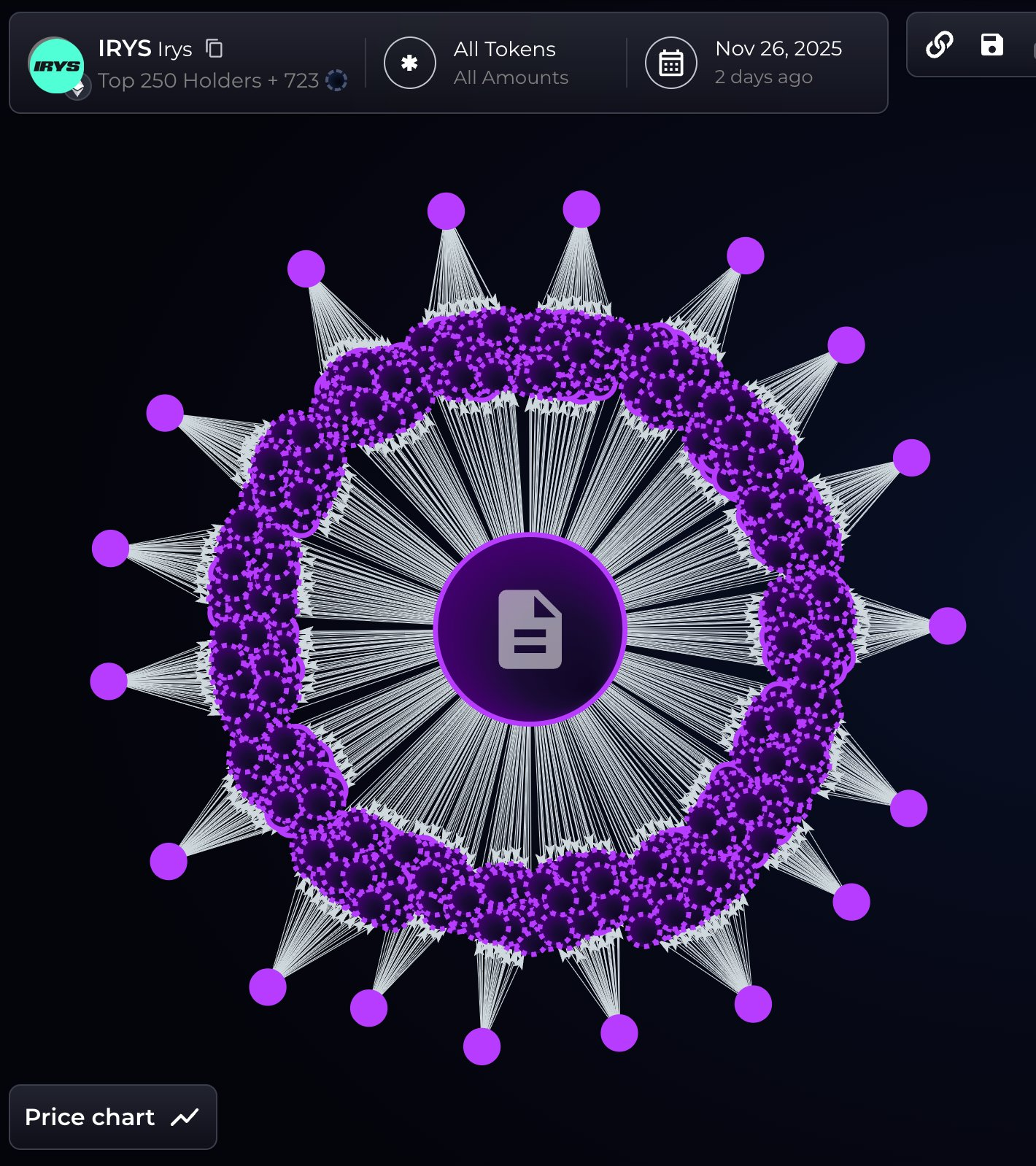
IRYS Token Address Clusters. Source: BubbleMaps

The flow of tokens, valued at approximately $4 million, indicates a likely preparation to liquidate the position. Such a move could introduce significant sell-side pressure on the asset’s order book.

IRYS price has come under pressure following the disclosures. The token has declined 16% over the past 24 hours and is trading near $0.032 as of press time.

Bubblemaps noted that it found no on-chain evidence linking the IRYS team to the wallet cluster.

Irys markets itself as an “on-chain AWS” designed for data storage and smart-contract execution.

The protocol has raised more than $13 million from venture capital investors and listed its token this week on major exchanges, including Binance and Coinbase.

Crypto Needs Stronger Sybil Protection

The episode highlights a structural challenge facing crypto projects that rely on airdrops to expand ownership.

Indeed, Irys allocated 8% of its total supply to the event. The goal was to distribute tokens to early users and help decentralize the network.

Instead, the concentration of tokens in a single cluster shows how airdrops remain vulnerable to actors using large batches of script-generated wallets to capture outsized allocations.

When one entity controls 20% of the initial circulating float, market observers say the result is heightened centralization risk and distorted price discovery.

Meanwhile, incidents like this point to broader limitations in token distribution practices across permissionless ecosystems. These environments have minimal identity checks and unrestricted network access.

This IRYS episode shows how difficult it is to prevent coordinated airdrop capture without stronger filtering, better identity heuristics, or more robust pre-distribution reviews.

Without those safeguards, early liquidity events can disproportionately benefit short-term actors. That dynamic can weaken outcomes for long-term holders and overall network stability.


Piyasa Fırsatı
Irys Logosu
Irys Fiyatı(IRYS)
$0.01434
$0.01434$0.01434
+10.64%
USD
Irys (IRYS) Canlı Fiyat Grafiği

Get Covered, Share 1M USDT

Get Covered, Share 1M USDTGet Covered, Share 1M USDT

Higher VVIP tiers, higher compensation odds.

Sorumluluk Reddi: Bu sitede yeniden yayınlanan makaleler, halka açık platformlardan alınmıştır ve yalnızca bilgilendirme amaçlıdır. MEXC'nin görüşlerini yansıtmayabilir. Tüm hakları telif sahiplerine aittir. Herhangi bir içeriğin üçüncü taraf haklarını ihlal ettiğini düşünüyorsanız, kaldırılması için lütfen crypto.news@mexc.com ile iletişime geçin. MEXC, içeriğin doğruluğu, eksiksizliği veya güncelliği konusunda hiçbir garanti vermez ve sağlanan bilgilere dayalı olarak alınan herhangi bir eylemden sorumlu değildir. İçerik, finansal, yasal veya diğer profesyonel tavsiye niteliğinde değildir ve MEXC tarafından bir tavsiye veya onay olarak değerlendirilmemelidir.

Ayrıca Şunları da Beğenebilirsiniz

Not a loophole: Singapore AI export controls let China tap US AI legally

Not a loophole: Singapore AI export controls let China tap US AI legally

American AI technology is reaching Chinese tech giants through a route that US export controls were never designed to close: Singapore. The city-state sits outside
Paylaş
The Cryptonomist2026/07/10 14:46
CME Group to launch Solana and XRP futures options in October

CME Group to launch Solana and XRP futures options in October

The post CME Group to launch Solana and XRP futures options in October appeared on BitcoinEthereumNews.com. CME Group is preparing to launch options on SOL and XRP futures next month, giving traders new ways to manage exposure to the two assets.  The contracts are set to go live on October 13, pending regulatory approval, and will come in both standard and micro sizes with expiries offered daily, monthly and quarterly. The new listings mark a major step for CME, which first brought bitcoin futures to market in 2017 and added ether contracts in 2021. Solana and XRP futures have quickly gained traction since their debut earlier this year. CME says more than 540,000 Solana contracts (worth about $22.3 billion), and 370,000 XRP contracts (worth $16.2 billion), have already been traded. Both products hit record trading activity and open interest in August. Market makers including Cumberland and FalconX plan to support the new contracts, arguing that institutional investors want hedging tools beyond bitcoin and ether. CME’s move also highlights the growing demand for regulated ways to access a broader set of digital assets. The launch, which still needs the green light from regulators, follows the end of XRP’s years-long legal fight with the US Securities and Exchange Commission. A federal court ruling in 2023 found that institutional sales of XRP violated securities laws, but programmatic exchange sales did not. The case officially closed in August 2025 after Ripple agreed to pay a $125 million fine, removing one of the biggest uncertainties hanging over the token. This is a developing story. This article was generated with the assistance of AI and reviewed by editor Jeffrey Albus before publication. Get the news in your inbox. Explore Blockworks newsletters: Source: https://blockworks.co/news/cme-group-solana-xrp-futures
Paylaş
BitcoinEthereumNews2025/09/17 23:55
Bitcoin, Gold, and U.S. Stocks Dive as Trump Pledges to Hit Iran ‘Extremely Hard’

Bitcoin, Gold, and U.S. Stocks Dive as Trump Pledges to Hit Iran ‘Extremely Hard’

The post Bitcoin, Gold, and U.S. Stocks Dive as Trump Pledges to Hit Iran ‘Extremely Hard’ appeared on BitcoinEthereumNews.com. In brief Bitcoin dropped Thursday
Paylaş
BitcoinEthereumNews2026/04/02 17:57

Gold at $4,000: Time to Buy?

Gold at $4,000: Time to Buy?Gold at $4,000: Time to Buy?

Central banks buy. $5K in sight, but rates weigh.