

Despite return-to-office-crackdowns, remote work is alive and well as the rate has barely changed over the last two years
For more than a year, Corporate America has projected confidence that remote work was nearing its end.
Amazon ordered employees back to the office five days a week last year. Meanwhile CEOs like JPMorgan’s Jamie Dimon and Tesla’s Elon Musk have repeatedly criticized work-from-home.
Yet despite the headlines, the American workplace has barely changed.
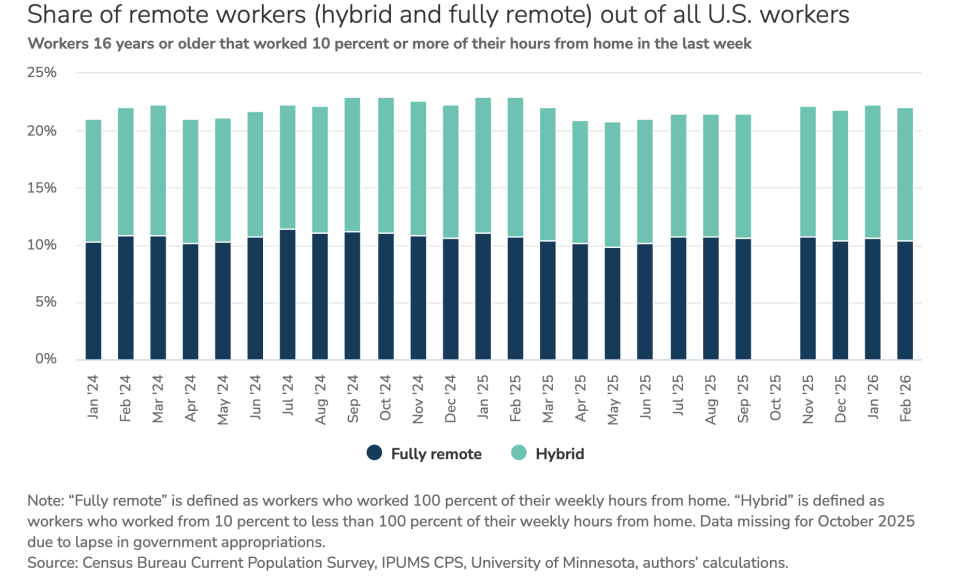
Nearly 22% of U.S. workers still worked from home at least part of the time in 2025, a percentage point less than in 2024, according to a new analysis of Census Bureau Current Population Survey data from the Federal Reserve Bank of Minneapolis.
The trend continued into 2026, with the combined rate of hybrid work and fully remote work running at 22.3% in January and 22% in February.
Kyle de Bruin, managing director at workplace research firm Leesman, said his firm’s surveys of roughly 100 to 130 large companies back this data up.
“About 3% of those companies are fully in office five days a week,” de Bruin said. “The noise you hear in the industry about the JPMorgans and the other big banks that are fully back, they are actually a minority.”
Workers who spent at least 10% of their workweek at home made up a quarter of the workforce in 2025, while average hours worked remotely slipped only slightly, from 27 hours at the beginning of the year to 26 hours a year later.
De Bruin said many companies have discovered that mandates alone are difficult to sustain because employees still aren’t convinced they need to be in the office every day.
“The why is not clear, and people know that they can feel it in their bones when they go into an office, and it doesn’t make sense,” he said.
Still, there is also a growing body of evidence that remote work may not be a catch-all solution. The number of entry-level positions has recently plummeted as AI combined with remote work has led companies to prioritize senior hires over workers just starting out. Research from the Federal Reserve Bank of New York found just last month that remote work could account for a 64% rise in youth unemployment.
But some employers have concluded that expanding remote work remains a competitive advantage.
Deborah Saneman, CEO of payroll and HR software company Würk, spent nearly three decades working in traditional offices before taking the top role that had her lead a largely remote workforce from Jarrettsville, Md. Today, the company employs people across 22 states.
Since giving up the company’s 15,000-square-foot office in downtown Denver three years ago for a 600-square-foot WeWork space, the company’s job openings have attracted a growing pool of workers. One position drew more than 4,000 applicants this year compared with about 170 in 2020, according to Würk.
“Having this national footprint to find talent has really allowed us to really find and attract and retain quality talent that has expertise in the systems for which we use,” Saneman said.
She said managing a distributed workforce requires more deliberate communication and mentorship. The company took a step to rectify this with no-meeting Fridays. Instead of work meetings, these days are devoted to coaching and collaboration.
For now, the Census numbers indicate that calls predicting remote work’s demise may have been premature.
As for Würk, Saneman said the company doesn’t plan to change its approach anytime soon.
“I think there are definitely benefits to being in an office organization, but I think that we have done a pretty good job at balancing that work-life balance, maintaining an excellent culture and also a high-quality product and deliverable to our client,” said Saneman
This story was originally featured on Fortune.com


You May Also Like

‘My neighbor’s cat does this too’: Trump draws scorn for bizarre July 4 activity
Solana (SOL) Price: Is SOL the Best Long-Term Crypto Bet Right Now

Jim Cramer Calls AST SpaceMobile (ASTS) Stock a “Great Speculative” Buy



