

Robinhood Fell 6% This Week After Meta Targeted Its Hottest Business. Here’s Where the Stock Could Go in 2026
Key Stats for Robinhood Stock
- Current Price: $97.19
- Target Price (Mid): ~$200
- Street Target: ~$100
- Potential Total Return: ~105%
- Annualized IRR: ~17% / year
- Q1 2026 Earnings Reaction: (13.24%) (4/28/26)
Now Live: Discover how much upside your favorite stocks could have using TIKR’s new Valuation Model (It’s free) >>>
What Happened?
Robinhood Markets (HOOD) just learned how fast a growth story can become a target. The stock fell 5.87% to close at $97.19 on June 24, giving back part of a rally that carried it from the low $70s in April to above $105 in mid-June. The trigger was not an earnings miss. It was Mark Zuckerberg.
The market had spent six weeks falling for one part of the Robinhood story: prediction markets, the fast-growing business that lets users trade contracts on real-world outcomes. Then reports surfaced that Meta is building a competing prediction-markets app called Arena, with access to 3.56 billion daily users. Bulls who had just re-rated HOOD on that exact engine had to ask whether its lead was safe.
That tension is the story. Robinhood’s newest businesses are why the stock doubled off its lows, and why it dropped this week. The question the market cannot yet answer: does Meta’s entry threaten Robinhood’s economics, or did a crowded, overbought stock just find an excuse to cool off?
Why Robinhood Stock Dropped
On June 23, The New York Times reported that Zuckerberg directed a team to build Arena, and CNBC confirmed it. The app would run separately from Facebook and Instagram and launch on a points-based system rather than real money, with cash betting left open as a later option. Robinhood, DraftKings, and Flutter all fell on the news.
The reaction makes sense. Prediction markets are Robinhood’s fastest-growing product line, and a rival with billions of built-in users skips the hardest part of the business, which is acquiring an audience. But the move also hit a stock that was already stretched. HOOD had run roughly 50% off its April lows on record June trading volumes, a 10% workforce cut framed as efficiency, and record traffic during the SpaceX IPO. A $2 billion convertible note offering priced on June 22 added pressure too. After a run like that, a competitive scare cuts deeper.
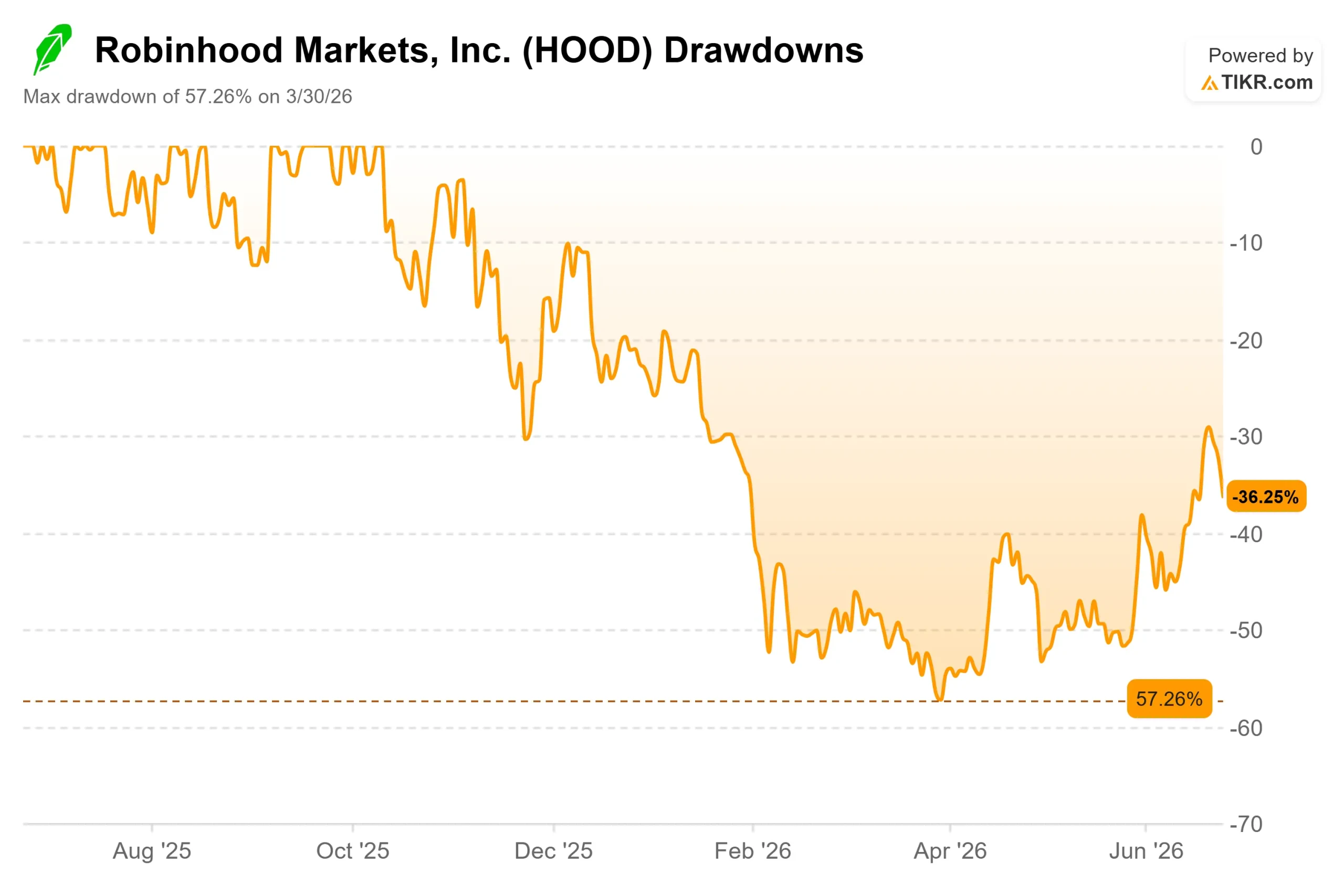 Robinhood Drawdowns (TIKR)
See historical and forward estimates for Robinhood stock (It’s free!) >>>
What Management Actually Built
Here, the panic and the business diverge. Robinhood did not just add prediction markets to its app. It built the plumbing. At the Piper Sandler conference on June 4, Chief Brokerage Officer Steven Quirk explained the logic behind Rothera, Robinhood’s own joint-venture exchange built with Susquehanna. The goal, he said, is to route order flow to any venue while keeping control of the economics, taking the cut Robinhood once handed to Kalshi and passing it to customers instead.
That reframes the competitive question. Robinhood’s edge is not that it owns the only place to trade event contracts. It is that Robinhood controls the distribution and increasingly the exchange economics for its 27.5 million customers. Quirk also addressed the fear investors now have about Meta: cannibalization. “Every time that I’ve ever launched a new product, my CFO and finance team are always worried about cannibalization,” he said. “Most of the time, they’ve been additive.” A larger, more visible category can grow the whole market, and a points-based Meta app with no real-money trading is not yet competing for the same revenue.
The Catalysts Meta Did Not Touch
The Arena headline overshadowed a strong month. The Pattern Day Trader rule, which forced traders with under $25,000 to limit day trading, was removed effective June 4. Robinhood estimates roughly 25% of its funded accounts sat under that threshold, and none of that unlocked volume has appeared in reported numbers yet.
May’s operating data backed the momentum, with platform assets reaching $377 billion, up 48% year over year, across 27.7 million funded customers. Bernstein projects that prediction-markets revenue could reach around $586 million in 2026, up from roughly $150 million in 2025. The soft spot stays crypto, where in-app volume fell about 50% year over year in May, the same weakness that drove the13.24% earnings-day drop on April 28.
On valuation, HOOD trades near 41 times next-twelve-month earnings, a premium to Interactive Brokers at around 36 times but a discount to Coinbase at around 57 times. That middle ground is the market’s verdict: faster-growing than IBKR, less crypto-exposed than Coinbase. The premium holds only if the new revenue lines keep scaling, which is exactly what Meta now puts on trial.
 Robinhood Revenue & EBITDA (TIKR)
See how Robinhood performs against its peers in TIKR (It’s free!) >>>
TIKR Advanced Model Analysis
- Current Price: $97.19
- Target Price (Mid): ~$200
- Potential Total Return: ~105%
- Annualized IRR: ~17% / year
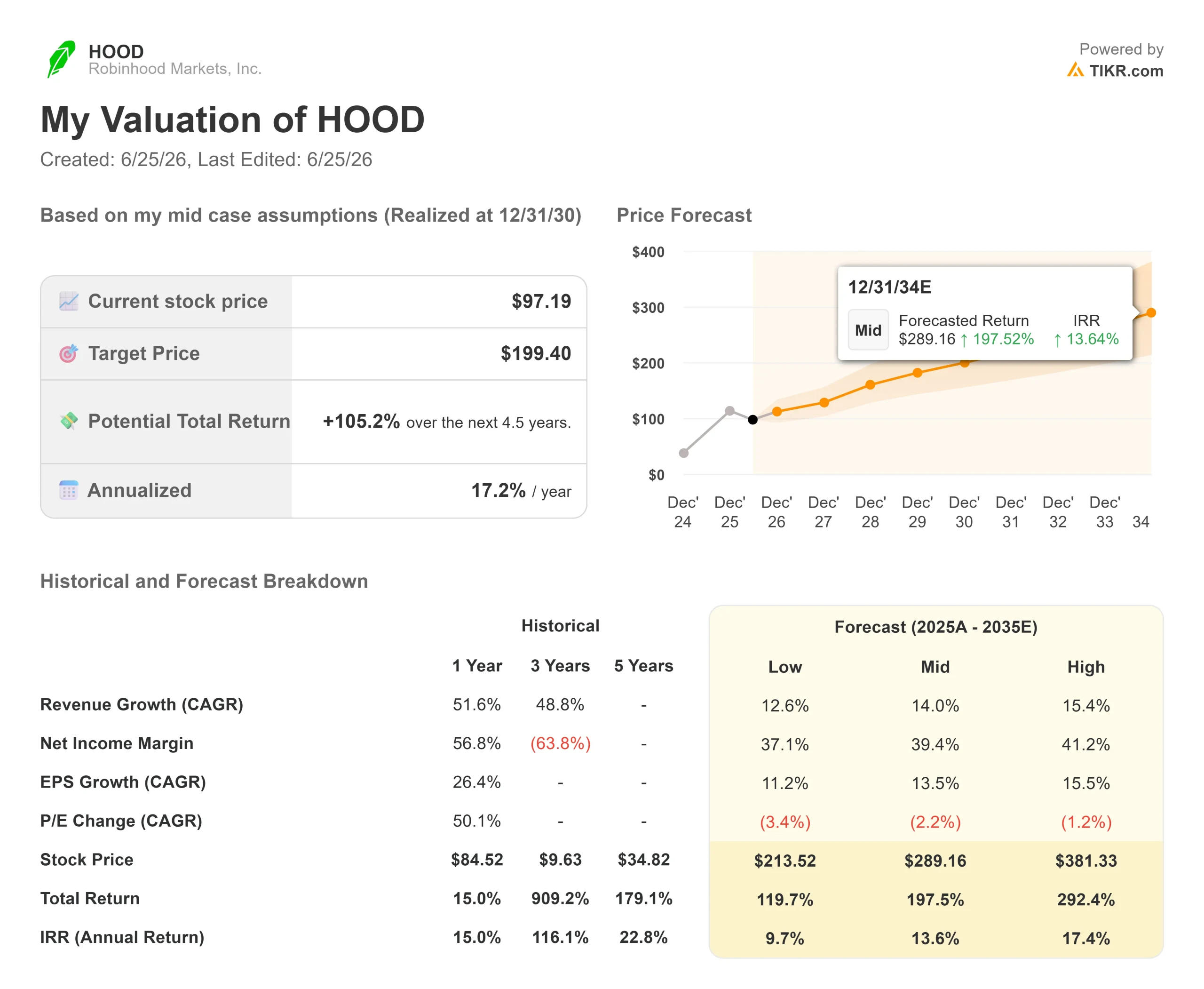 Robinhood Advanced Valuation Model (TIKR)
See analysts’ growth forecasts and price targets for Robinhood stock (It’s free!) >>>
Using TIKR’s mid-case scenario, the model targets around $200 for HOOD, about 105% total return, and roughly a 17% annualized return over the next 4.5 years. The two revenue drivers are prediction-markets and event-contract expansion monetized through Rothera, plus net interest and Gold subscription growth across a base of 27 million customers. The margin driver is operating leverage, with mid-case net income margins near 39% as revenue scales and the 10% workforce cut trims costs. The primary risk is transaction-revenue volatility: a sustained crypto slump or a credible Meta product would pressure both growth and the multiple. The upside is the diversification thesis proving real and the market re-rating HOOD as a durable platform. The downside is competition compressing prediction-markets economics while a stock near 41 times earnings drifts toward its peers.
Conclusion
The number that settles this is prediction-markets and event-contract revenue at Q2 2026 earnings, expected in late July. Good looks like that line growing sequentially with Rothera taking a visible share, plus total revenue holding mid-teens growth as the PDT change feeds volumes. Bad looks like crypto softness defining another quarter, while the new businesses stay too small to offset it. Arena has no launch date and no real-money trading, so the immediate test is not whether Zuckerberg can compete someday. It is whether Robinhood’s own engine is already running fast enough to make that question secondary.
See what stocks billionaire investors are buying so you can follow the smart money with TIKR.
Should You Invest in Robinhood?
The only way to really know is to look at the numbers yourself. TIKR gives you free access to the same institutional-quality financial data that professional analysts use to answer exactly that question.
Pull up Robinhood, and you’ll see years of historical financials, what Wall Street analysts expect for revenue and earnings in the quarters ahead, how valuation multiples have moved over time, and whether price targets are trending up or down.
You can build a free watchlist to track Robinhood alongside every other stock on your radar. No credit card required. Just the data you need to decide for yourself.
Analyze Robinhood on TIKR Free →
Looking for New Opportunities?
- See what stocks billionaire investors are buying so you can follow the smart money.
- Analyze stocks in as little as 5 minutes with TIKR’s all-in-one, easy-to-use platform.
- The more rocks you overturn… the more opportunities you’ll uncover. Search 100K+ global stocks, global top investor holdings, and more with TIKR.
Disclaimer:
Please note that the articles on TIKR are not intended to serve as investment or financial advice from TIKR or our content team, nor are they recommendations to buy or sell any stocks. We create our content based on TIKR Terminal’s investment data and analysts’ estimates. Our analysis might not include recent company news or important updates. TIKR has no position in any stocks mentioned. Thank you for reading, and happy investing!


You May Also Like

Dzulkefly announces immediate RM805,700 allocation for Senawang health and dental clinics

Left Singapore during Covid, lost PR and returned to a S$9,000 national service fine
BitMart Secures Australian Financial Services Licence, Reinforcing Global Compliance Framework



