

FAST FACTS: What are rip currents and how to survive them?
The drowning of Ateneo Blue Eagles student-athletes Rene Baterbonia and Divine Adili during a team-building activity in Dipaculao, Aurora has made the rounds on social media.
With speculations coming from all directions, Ateneo president Father Roberto Yap SJ said in a statement that the team was carried away by rip currents near the shoreline. But what exactly are rip currents, the hidden hazard in coastlines? And how does one survive them?
A rip current is a narrow and fast-moving current that flows away from the shore and into deeper waters.
When waves reach the shore, they pile up and seek a balance, looking for the path with the least resistance, which eventually leads to a channel of water that funnels backward to deeper waters, hence the term “rip.”
These currents typically reach speeds of one to two feet per second but can move up to a maximum speed of eight feet per second — faster than an Olympic swimmer, according to the National Oceanic and Atmospheric Administration (NOAA).
Casualties from drowning occur in this situation, as swimmers are pulled away from the shoreline.
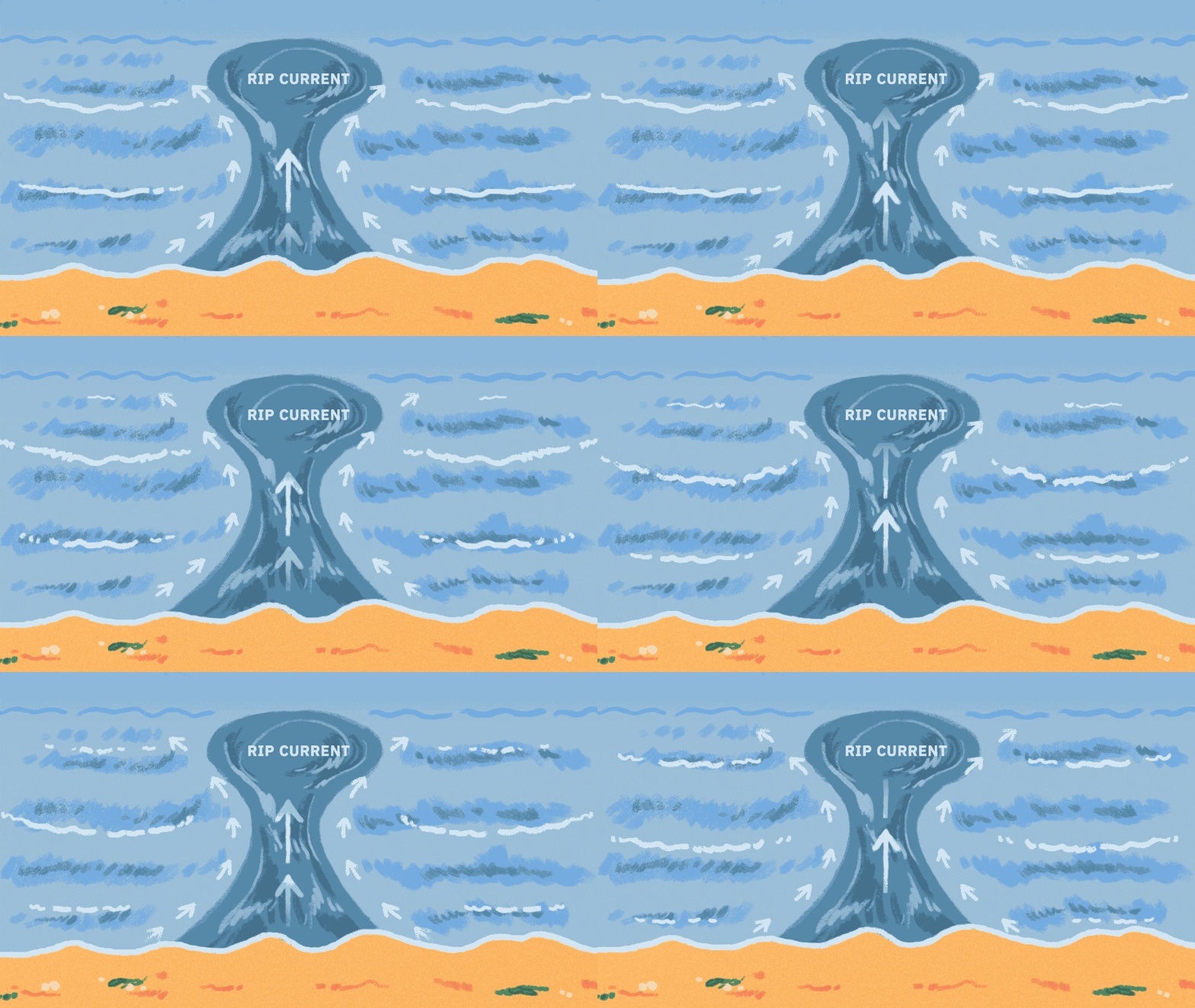 Illustration by David Castuciano/Rappler.com
Rip tide vs rip current: What’s the difference?
Many often use the two terms interchangeably, but rip tides and rip currents are two completely different ocean phenomena, the National Weather Service (NWS) says.
Though both refer to strong, narrow currents of water pulling swimmers away, rip tides are caused by local tides, usually coming from a high to low tidal cycle, leading to a stronger force for the outgoing water. NOAA explains it in simple terms: tides go up and down, while currents move left and right.
Rip tides or tide-driven currents can also be seen in funneled, narrower channels of water, such as river mouths, according to the National Hydraulic Research Center (NHRC). Their hydraulic data shows that it manifests at specific river discharge points, as water flushes away from shore, making it localized and often fixed locations.
What causes rip currents?
Rip currents are caused by the weather, specifically the wind. Water is pushed up along the coast, and as it retreats back after the waves break, water that found lesser resistance picks up momentum, leading to a fast-moving channel that drags whatever it catches into the sea.
It is more frequent, wider, and faster during storms as massive energy is generated, pushing larger volumes of water to shore. In the Philippines, more tropical cyclones enter its area of responsibility than any other region in the world, with an average of 20 per year, according to Philippine Atmospheric, Geophysical and Astronomical Services Administration (PAGASA).
Like storm exposure, eastern shores are more prone to rip currents brought by the Pacific Ocean.
What are dangers, signals to look out for?
According to the NWS, rip currents can be more easily detected when coming from a higher vantage point, where the following can be noticed:
- a narrow gap of darker and “calmer” water in between areas of breaking waves and whitewater
- different from the ocean water, often muddier or darker than normal
- line seaweeds, sand, or debris steadily moving out into deeper waters
- scalloped embayments forming eroded shorelines
The speed of the currents may vary and at the same time can change in speed quickly, where even the strongest swimmer or even heavy objects may be dragged away. It can be even more dangerous for weak or non-swimmers.
How to survive them?
Drowning from rip currents can be prevented. Before entering the water, NOAA advises swimmers to:
- know basic swimming skills
- make sure there’s a lifeguard near shore on standby and consult before swimming
- not swim alone
When caught in a rip current, the United States Lifesaving Association (USLA) advises swimmers not to panic and not swim against the current but parallel to the shore to escape the narrow channel.
- If exhausted, tread the water as it loses momentum further out
- If available, utilize any floating device, such as boards or salbabidas
- If you feel you won’t reach the shore, draw attention and ask for assistance
- If there are no lifeguards in the area, call for emergency assistance
For rip tides, avoid narrower channels of water, especially when changing from high to low tides. – Rappler.com


You May Also Like

Moody’s Assigns First-Ever Rating to Bitcoin-Backed Municipal Bond in Historic Crypto Finance Move

EUR/JPY Stalls: Critical 184.00 Level Holds as Markets Decipher ECB and BoJ Policy Signals

Japanese Tech Giant’s Ambitious Bitcoin Accumulation



