

10 Tuesday AM Reads
My Two-for-Tuesday morning train WFH reads:
• How to Earn a Billion Dollars. Someone replied that having a few million and growing at 93% a month was radically different from being a billionaire. I suspect many people would agree with this statement. But it turns out not merely to be false, but false in a very illuminating way. So I would like you all to do me a favor please. I would like you to take out your phones and calculate a number: compound 93% monthly on 2 million for a year… (Paul Graham)
• Want to Delay RMDs From Your 401(k)? Don’t Retire: Barron’s on the still-working exception that delays RMDs from a current employer’s 401(k). Niche, but useful for the right reader. (Barron’s)
• Triple-Digit Club: A Wave of Stocks Have Seen Huge Gains in 2026: Morningstar on the surprisingly broad set of 100%+ YTD names in 2026. The market isn’t quite as narrow as the index would suggest. (Morningstar)
• The Tiny Solar Panel That Could Change America: A technology — known as plug-in, balcony or garden solar — is already enormously popular in Germany, in part because you can buy a kit for less than $600 at IKEA. It’s a small solar panel system, often producing up to 1,200 watts of electricity, or a little more than a refrigerator consumes, that you can affix to a wall, hang on a railing or prop up in a garden — and then plug directly into a wall socket. With the help of a small device called a micro inverter, it pumps electricity into your household circuits to offset your power demand. (New York Times)
• Brutally honest guide to not losing money in the market: A straightforward read-the-room piece on capital preservation in markets that look priced for perfection. The boring rules still work. (Yahoo News)
• The Untold Story of the Google Buses That Took Over San Francisco: A decade ago, commuter buses attracted big protests in San Francisco. Years later, the city is still feeling the repercussions. A book excerpt revisiting how the Google bus became a symbol of everything San Francisco loves and hates about tech. Better history than you’d expect.A decade ago, commuter buses attracted big protests in San Francisco. Years later, the city is still feeling the repercussions. (Wired)
• They’re calling it the end of the war. It’s a tactical pause, nobody’s signed a damn thing, and the terms hand Iran the win. Don’t call this the end of the war. This is a tactical pause and a dangerous part of the political game. Others are calling it that, and they are wrong, or at least early. Read the terms and tell me who truly won. Iran keeps the Strait, keeps the enrichment, gets twenty-four billion dollars back, and the disarmament gets shoved into sixty days of talks Iran swears it will not lose. Israel is calling it a surrender. It swallowed the loss on Iran and bombed Beirut instead, and Iran says a response is coming. Nothing is signed, and Friday is a long way off. (The Omission) see also Trump Winds Down the War He Started With Goals Unmet: NYT on the gap between the original Iran-war objectives and what the deal actually delivers. The exit ramp is less a strategy than a relief. While the president says the agreement with Iran would open the Strait of Hormuz and provide economic relief, the country’s nuclear program is still a subject for negotiation. (New York Times) see also The peace deal with Tehran is an Iranian victory.The Atlantic’s take on the Iran deal as a face-saving retreat dressed up as victory. The talking points and the terms don’t line up. The peace deal with Tehran is an Iranian victory. (The Atlantic)
• Pickiness tastes like trauma How American children became the fussiest eaters in history (and why they need to check their not-dying privilege). But it turns out that Picky is not about what modern parents are doing wrong. Helen is a historian and she traces a wide variety of factors across hundreds of years—things like industrialization of the food supply chain, advertising and its consequences, and the weaponization of parental anxiety for nefarious purposes—to explain how we got here as a culture. https://www.oaklandreviewofbooks.org/picky-book-review/
• Where Did Earth Get Its Oceans? Maybe It Made Them Itself.: Quanta on new evidence that Earth synthesized much of its water internally rather than importing it via comets. A small but profound rewrite of the origin story. At first, scientists thought Earth’s water came from comets. Then, asteroids. Now, they wonder if Earth’s water is homegrown. (Quanta Magazine)
• The Mastermind Who Built the Knicks—One Outrageous Gamble at a Time: When Leon Rose came to New York in 2020, the Knicks had gone decades without a chance at a title. But the team’s president turned them into the ultimate winners by building a roster of underdogs. WSJ on Leon Rose and the front-office gambits that built this Knicks roster. The contrarian moves are easier to admire after the fact. (Wall Street Journal) see also How Can You Not be Romantic About NYC? God Bless Jalen Brunson:.Jack Raines on what it’s like to live in New York right now — the Knicks, the noise, the grind, the moments that justify the rent. A perfect Sunday read. (Young Money)
Video of the day: The Powell years at the Fed: A retrospective
Be sure to check out our Masters in Business interview this weekend with Jean Eric Salata, Chair of EQT Group and Chair of EQT Asia. EQT is a purpose-driven global investment organization with over $310 billion in total assets under management, making it the largest private markets firm headquartered outside the United States.
Building capacity to produce exposed products would require a shift in capital investment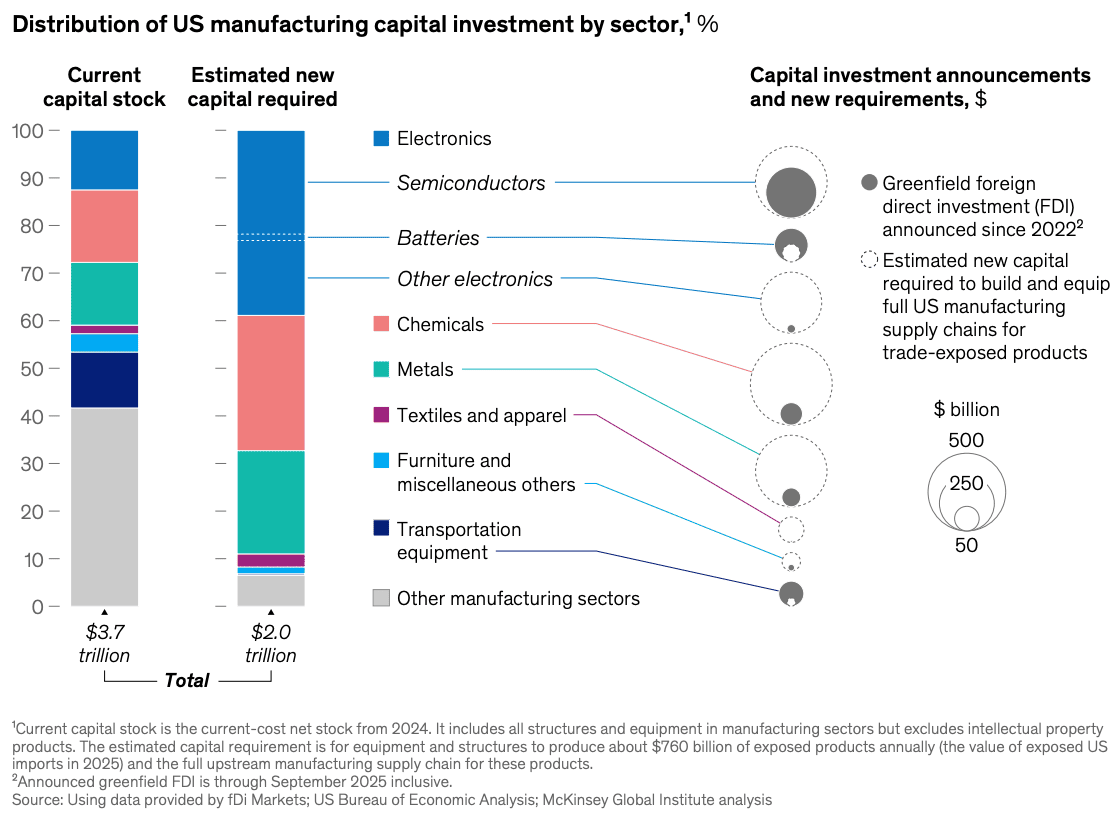
Source: McKinsey
Sign up for our reads-only mailing list here.
The post 10 Tuesday AM Reads appeared first on The Big Picture.


You May Also Like
Redwood AI Corp. Leverages Artificial Intelligence to Accelerate Chemistry R&D Across Multiple Industries
SUI Price Prediction: Analyst Says a 10X Rally Is Still Possible

Best Music AI Websites For Songs And Soundtracks



