

4.2% inflation kills rate cut hopes: the rising inflation impact on crypto
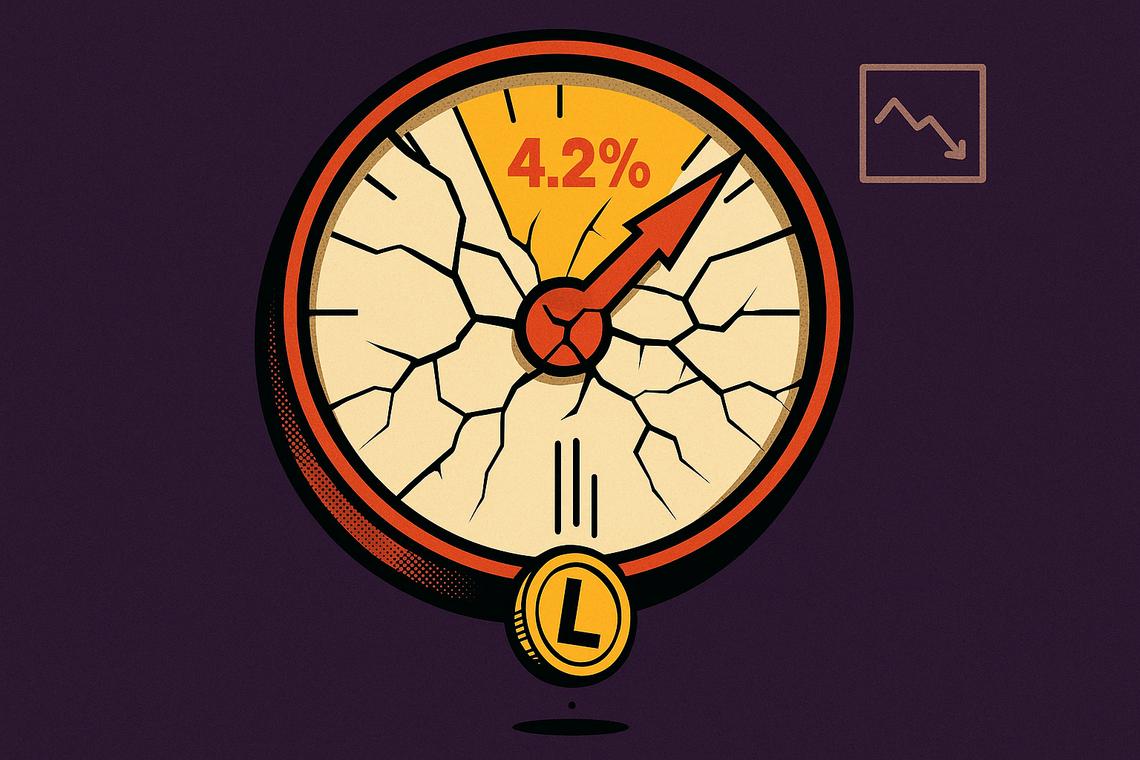
When PepsiCo slashes prices by up to 15% on Lay’s and Doritos, it isn’t just a marketing decision — it’s an economic signal. The snack giant’s Q2 2026 results offer one of the clearest real-world snapshots yet of how the rising inflation impact on American households is feeding through into actual consumer behavior, and what that might mean for risk assets sitting further along the same chain.
Key takeaways
- PepsiCo posted Q2 2026 net revenue of $24.2 billion, up 6.4%, but growth came almost entirely from international markets as North American food sales fell 2%.
- US CPI inflation reached 4.2% in May 2026, the highest since April 2023, partly driven by elevated oil prices tied to the Iran conflict.
- PepsiCo cut prices up to 15% on core brands and maintained full-year guidance of 2–4% organic revenue growth and 4–6% core EPS growth.
- South Korea’s Ministry of Economy and Finance auctioned 800 billion KRW in 50-year Treasury bonds at a 4.345% yield, near all-time highs.
- Bitcoin and crypto historically underperform during high-inflation, high-rate environments — the exact conditions now taking shape.
PepsiCo’s mixed Q2 2026 results reveal a domestic consumer under pressure
The headline number looks respectable. PepsiCo reported Q2 2026 net revenue of $24.2 billion, a 6.4% increase year-over-year. But strip away the international contribution and the domestic picture looks notably different.
International growth masks a North American retreat
The revenue gain was driven largely by overseas markets. Back home, North American food sales declined 2% year-over-year. Consumers are actively trading down — reaching for smaller pack sizes and cheaper alternatives rather than the full-size staples they bought before. It is the kind of behavioral shift that doesn’t reverse quickly once it sets in.
Price cuts on Lay’s and Doritos signal real stress
PepsiCo’s response has been direct: cut prices by up to 15% on core brands like Lay’s and Doritos. For a company that spent years managing inflation by quietly shrinking pack sizes and holding price points, this reversal speaks volumes. Management flagged greater-than-expected consumer pullback during earnings commentary, and the company is projecting even higher commodity costs in the second half of 2026.
To navigate that squeeze, PepsiCo plans to ramp up marketing spend, push health-focused product innovation, and lean harder on productivity measures. Despite all the headwinds, the company maintained its full-year guidance of 2–4% organic revenue growth and 4–6% core constant-currency EPS growth — a show of resilience, though one that carries its own set of conditions.
Rising US inflation and the oil price shock compounding it
US CPI inflation hit 4.2% in May 2026, the highest reading since April 2023. That single number carries an outsized amount of meaning for interest rate expectations, consumer budgets, and asset prices across the board.
The Iran conflict’s role in keeping fuel costs elevated
High fuel costs are a major contributing factor. Elevated oil prices tied to the Iran conflict have compounded inflationary pressures already embedded in food and commodities. Fresh US strikes on Iran and Donald Trump’s suggestion that the ceasefire was “over” sent Brent crude climbing over 5% to around $77.86 a barrel, with gas prices jumping sharply alongside. About a fifth of the world’s liquefied natural gas supplies typically pass through the Strait of Hormuz, and any sustained disruption there feeds directly into energy costs globally.
South Korea’s Kospi fell 5.5% in a single session as the geopolitical shock reverberated across Asian markets. European bond yields rose to near one-month highs on inflation fears. The chain reaction from a Middle East flare-up to a grocery store price cut in the US is not abstract — it is unfolding in real time across earnings reports and market data.
What 4.2% inflation means for monetary policy and markets
A persistent inflation reading above 4% effectively kills any remaining expectations for rate cuts in 2026. The Federal Reserve’s higher-for-longer framework stays intact, which reshapes the investment calculus across asset classes. Tighter monetary conditions compress liquidity. And compressed liquidity tends to hit the riskiest parts of the market hardest.
This is where the rising inflation impact reaches beyond consumer staples and into crypto territory.
What this environment means for Bitcoin and crypto
Bitcoin’s narrative as an inflation hedge has never held up cleanly during periods when inflation is rising alongside interest rates. Historically, Bitcoin and crypto broadly perform best when liquidity is expanding and real interest rates are falling — the opposite of current conditions. In high-inflation, high-rate environments, Bitcoin has tended to behave more like a high-beta tech stock than a store of value, amplifying drawdowns rather than offsetting them.
When even recession-resistant consumer staples show softening demand, it suggests average households are under genuine financial stress. Discretionary investment — whether in growth stocks, venture capital, or digital assets — gets squeezed at exactly this point in the cycle. The macro backdrop that PepsiCo’s earnings illustrate is not incidental to crypto markets. It is directly relevant to where marginal capital flows next.
South Korea’s 50-year Treasury bond auction signals a shifting capital allocation
South Korea’s Ministry of Economy and Finance auctioned 800 billion KRW in 50-year Treasury bonds on July 10, with settlement three days later. The yield came in at 4.345%, near the all-time high of 4.39% touched on July 8 — and representing a 1.68 percentage point jump compared to a year ago.
Why Korean bond yields matter beyond Seoul
South Korea is not a marginal player in the global crypto ecosystem. Domestic exchanges like Upbit have regularly ranked among the world’s highest-volume platforms, and Korean retail traders have historically been among the most active participants in digital asset markets. When Korean fixed-income instruments start offering yields that would once have seemed generous even for corporate bonds, the decision framework for those traders changes.
South Korea first introduced 50-year Treasury bonds in 2016, initially pricing them at roughly 4 basis points above the 10-year benchmark — a modest spread that reflected investor confidence in extending duration. A 1.68 percentage point rise in yield over 12 months tells a very different story now. Existing holders of older 50-year bonds have absorbed substantial mark-to-market losses; duration risk on a 50-year instrument is enormous, with a 100 basis point move potentially translating to a price swing of 20% or more.
The hurdle rate problem for risk assets
When a G20 sovereign offers 4.3% risk-free over 50 years, it establishes a floor for what institutional allocators consider acceptable returns. Private credit, venture capital, and crypto all need to clear that hurdle rate to attract marginal capital. The 800 billion KRW issuance is part of a broader government financing strategy aimed at extending the yield curve and locking in long-duration funding — but the side effect is a competitive gravitational pull toward fixed income and away from higher-risk alternatives.
The absence of any crypto-related commentary from Korean financial authorities around this bond auction is itself telling. Traditional finance is operating in its own lane, setting benchmarks that crypto must contend with whether or not the two worlds acknowledge each other directly.
Taken together — PepsiCo’s domestic revenue contraction, US CPI at a three-year high, oil price shocks from an escalating Iran conflict, and a Korean sovereign yield near record highs — the macro picture that crypto investors need to monitor is becoming harder to ignore. The question isn’t whether these forces will affect digital asset markets. It’s how long before that pressure becomes unmistakable in the price data.
FAQ
Why did PepsiCo cut prices on popular brands like Lay’s and Doritos?
PepsiCo cut prices by up to 15% on core brands like Lay’s and Doritos in response to a notable consumer pullback driven by inflationary pressure. American households are increasingly trading down to smaller pack sizes and cheaper alternatives, forcing the company to adjust pricing on its most recognized products to defend market share.
How does the current inflation environment affect crypto markets?
Bitcoin and crypto broadly have historically performed best when liquidity is expanding and real interest rates are falling. With US CPI at 4.2% in May 2026 — the highest since April 2023 — rate cuts remain unlikely and higher-for-longer monetary policy stays in place. That environment reduces the liquidity conditions that have traditionally supported crypto valuations, pushing digital assets to behave more like high-beta risk assets than inflation hedges.
What is the significance of South Korea’s 50-year Treasury bond yield for crypto investors?
South Korea’s Ministry of Economy and Finance auctioned 800 billion KRW in 50-year Treasury bonds at a 4.345% yield, near the instrument’s all-time high. That level sets a strong risk-free benchmark for institutional and retail investors alike. Given South Korea’s historically high retail crypto trading activity — with Upbit consistently among the world’s top exchanges by volume — a competitive fixed-income yield can meaningfully redirect capital away from digital assets toward government bonds.
What are PepsiCo’s plans to address rising commodity costs?
PepsiCo plans to increase marketing spend, accelerate health-focused product innovation, and implement tighter productivity measures to offset higher commodity costs projected for the second half of 2026. The company maintained its full-year guidance of 2–4% organic revenue growth and 4–6% core constant-currency EPS growth despite the headwinds.
Article produced with the assistance of artificial intelligence and reviewed by the editorial team.


You May Also Like
Goatseus Maximus (GOAT) Price Prediction 2026, 2027-2030

Not a loophole: Singapore AI export controls let China tap US AI legally

LIST: Bayanihan initiatives amid soaring oil prices



