Why Able Is Betting That The Next Stablecoin Winner Will Be Defined By Infrastructure, Not Payments
There is a financial market worth trillions of dollars that the global banking industry has largely failed to serve. Islamic finance assets currently stand at $4.93 trillion and are projected to reach $7.53 trillion by 2028 — yet access to compliant, user-friendly products remains stubbornly out of reach for the 2 billion population. The builders moving to close that gap are often those who lived it firsthand.
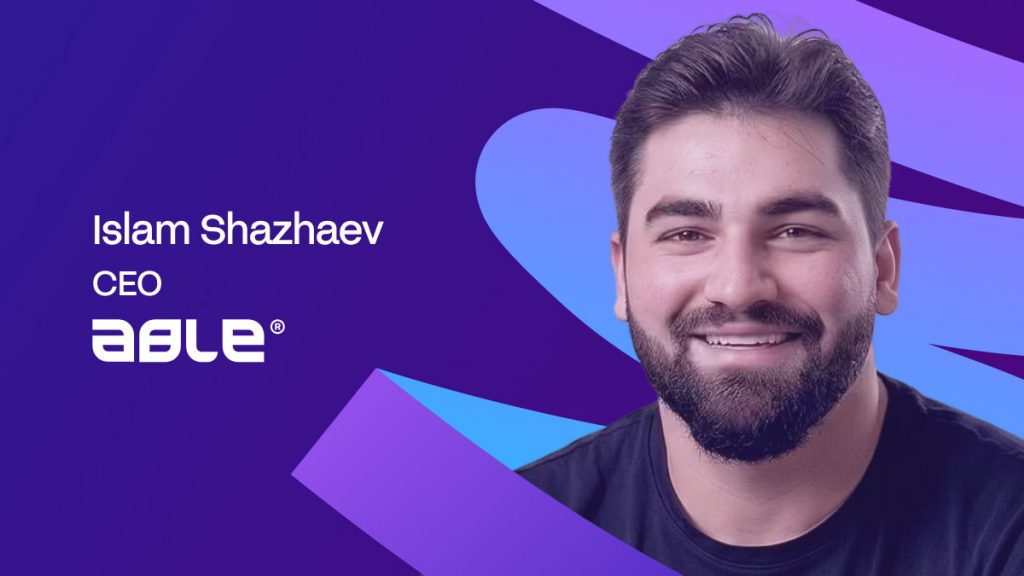
Islam Shazhaev, Founder & CEO of Able Finance, a serial entrepreneur with deep operational roots across the CIS region and the crypto economy, is positioning Able as the defining Sharia-compliant fintech platform for a global audience — combining stablecoin infrastructure, AI-native product architecture, and genuine on-the-ground market knowledge.
In this interview, he unpacks what it truly means to run an AI-native company, explains how the USDa stablecoin is structured to deliver compliant yield where existing instruments fall short, details what makes able.shield a genuinely active financial tool rather than a passive one, and lays out why he believes this moment — demographic, technological, and financial — is precisely the right one to build.
Can you tell us about Able? What was the key moment that made you realize Able needed to exist?
Able started from a problem I lived with. I never had a clean way to park my money somewhere I trusted — a place that protects it from losing value to global inflation and stays fully aligned with my faith. Across most of the world, truly halal financial options are either scarce or buried behind painful, exclusionary processes before you can access anything permitted.
My earnings come from crypto, and the gap became impossible to ignore. I could move value across the world in seconds, yet had nowhere halal to actually keep it. That was the moment Able made sense: a Sharia-aligned app where you download it, deposit stablecoins, and get halal yield straight from your phone.
The mission grows from there. Whether you are in Indonesia, Kazakhstan, Uzbekistan, or anywhere else, you should have the same access to halal financial tools — without needing the right passport, the right residency, or the right connections.
You describe Able as “AI-native.” What does that mean in practice from a technology and architecture perspective?
AI-native means the technology is woven into how the company actually runs, not bolted on as a feature. In practice, we have loaded our AI systems with as much context about Able as possible — our business model, goals, strategy, financials, risks, and operational decisions. This means AI functions less like a tool and more like a co-founder: one that generates scenarios we haven’t considered, stress-tests our strategies before we commit to them, and constantly surfaces blind spots or missing pieces in our thinking. It challenges our assumptions in real time, which keeps decision-making sharper and faster as we scale.
We rely on two models day to day. Claude from Anthropic handles higher-level reasoning, operational planning, internal documentation, compliance structuring, and our agentic and MCP workflows — turning messy context into a clear plan. Manus AI handles the research-heavy work: market mapping, competitor analysis, country-level breakdowns. It absorbs the volume so the people running Able can spend their time on judgment and the final call.
able.vault seems like one of your most geographically specific bets. What gap in the market are you addressing?
The gap is one I felt personally. Across most GCC markets, truly Sharia-compliant financial options are either scarce or difficult to access, leaving people sitting on money they can’t responsibly park anywhere, watching inflation chip away at it.
Standard products miss the fact that a large share of money in these communities moves outside the credit system on purpose. I use a debit card but never a credit card, and I’ve bought every major asset — cars, apartments, houses — in cash, because bank financing carries interest, and that’s a line I won’t cross.
USDa stablecoin is a core part of Able. Can you explain how it works?
USDa is our halal stablecoin and the second phase of what we’re shipping. Inside the app, it lives on its own screen, where you swap USDT or USDC directly into USDa, and a calculator shows the approximate yield you’d earn while holding it.
Stablecoins like USDC and USDT are backed partly by short-term US Treasuries, and the return on those reserves traces back to interest, which many scholars treat as riba. USDa is structured differently. Sharia compliance is governed by our independent Sharia board; they are the qualified scholars who define what is permitted and issue the Fatwa. That authority sits with them, not with us. The full picture on the issuer, infrastructure, and collateral model will be disclosed once we have onboarded our first partner and completed the appropriate review process.
Why build your own stablecoin rather than building Able’s yield features on top of an existing yield-bearing instrument?
Because the existing instruments carry the exact problem I’m trying to escape. With USDT or USDC, the reserve sits in interest-bearing assets, and once you build yield on top, you’ve inherited a return that traces back to interest.
Card providers and digital-dollar neobanks in our space — like Redot Pay and Kast — are competing on cards and distribution, but none are issuing a fully compliant stablecoin. That’s our main structural advantage.
You also have to be honest about what’s sustainable. When yield is engineered to fund inflated cashback, the economics eventually strain. Building our own coin lets us own the yield source and the compliance structure end-to-end, with our independent Sharia board providing oversight and standing behind every decision.
Tell us about able.shield. What does the AI layer do? What does that solve that standard neobank cards or crypto-native cards don’t?
Able Shield is an AI layer that sits on top of your card activity and actually works on your behalf. It monitors your spending and subscriptions, analyzes patterns, and can cancel unwanted subscriptions directly through merchant sources — not just flag them for you to deal with manually. The agent handles the action.
Standard neobank and crypto cards surface your transactions and stop there. The intelligence is on you. Able Shield closes that gap by turning passive visibility into active management — it notices what’s draining your balance quietly and removes it.
That’s the core of what we’re building. There’s a broader vision around values-based spending controls, but Shield starts with something immediately useful: your money stops leaking without you having to chase it down.
What user behaviors are you seeing across markets like the UAE, South Asia, and Southeast Asia. How are they influencing Able’s product strategy?
Most often, people are looking for somewhere to hold their money that keeps its value without compromising their faith. Across the Gulf, many residents hold wealth outside the credit system by choice, making large purchases in cash to avoid interest — and are actively looking for a halal place to put that value to work. Across South and Southeast Asia, the pull is access: people want in without needing a wealthy passport or a foreign bank account.
This shapes strategy directly: we optimized first for how easy it is to start — download, deposit, and be in. My own background feeds this. I’ve built businesses across several countries and worked on the ground in the CIS region — Uzbekistan, Tajikistan, Kazakhstan — so I have a feel for how these audiences actually behave.
The regional understanding is a real advantage, and it points the product toward the markets where the need is sharpest.
Looking five years ahead, what does success look like for Able?
Success is a family or founder anywhere having a financial home that fits them — with no compromise.
For families, that means tools woven through daily life: savings that grow, spending that reflects their values, and instruments built around how they actually live. That all-in-one experience simply doesn’t exist today.
For founders, the prize is bigger. An entrepreneur currently survives on bootstrapping, revenue, or outside investment, while the rest of the startup world can also tap bank credit and financial infrastructure we can’t touch. Five years from now, that founder should have access to halal financing, halal lending, and a real toolkit for building — not a workaround.
The deeper ambition is to become the defining fintech globally and to shift how business is perceived. I know our audience because I am this audience. And I genuinely believe that if a calm, credible product makes halal finance easy and accessible, the vast majority of us would move — but just haven’t had a real reason to yet.
The post Why Able Is Betting That The Next Stablecoin Winner Will Be Defined By Infrastructure, Not Payments appeared first on Metaverse Post.


You May Also Like

Crypto Hack: Drift Protocol Drained Over $200M in Private Key Breach
From Telegram to Terminal: Banana Gun’s Pro Platform Hits Ethereum as User Base Surpasses One Million