

Solana firm to support Kazakhstan’s $6B crypto megacity plan
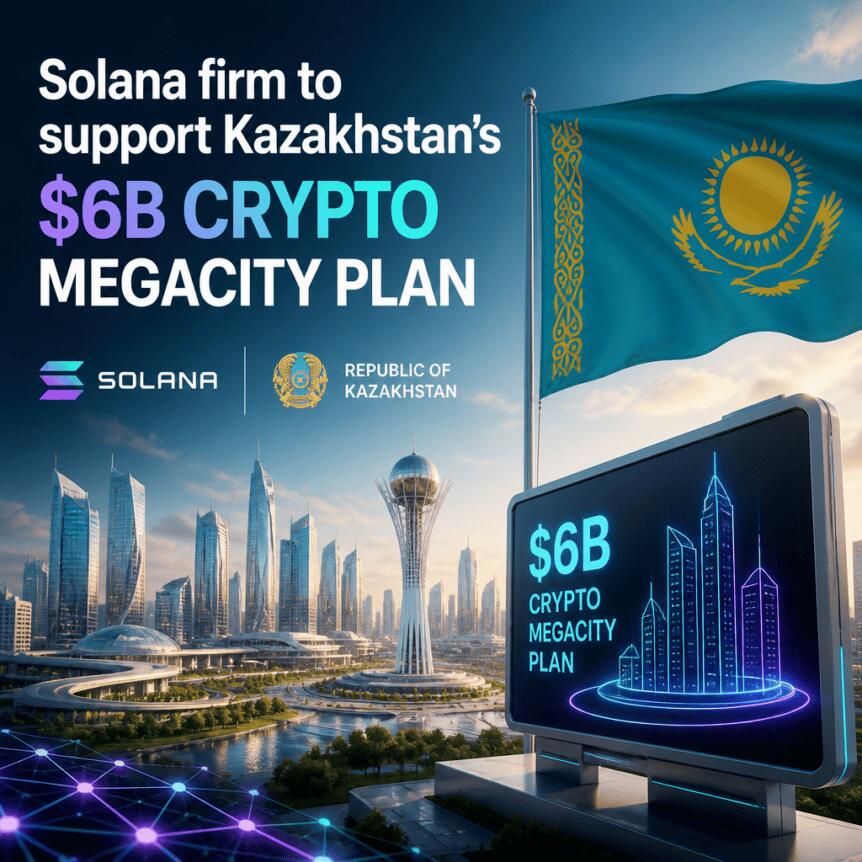
Solana Company has entered a formal partnership aimed at building the blockchain and crypto infrastructure for Alatau City, Kazakhstan’s planned digital-first megacity. The Nasdaq-listed firm signed a memorandum of understanding (MOU) during the Alatau City Roadshow in Shenzhen and Hong Kong in June, according to the report that said the event yielded 30 cooperation agreements with a combined investment potential of more than $6 billion.
Solana Company chairman and CEO Joseph Chee said the parties plan to deepen their relationship and expand Solana’s ecosystem presence across the region. The agreement also adds to Kazakhstan’s growing exposure to Solana-related initiatives, including a Solana Economic Zone launched in Astana last year in cooperation with the Solana Foundation.
Key takeaways
- Solana Company signed an MOU to advise on Alatau City’s blockchain and crypto infrastructure during the June roadshow in Shenzhen and Hong Kong.
- The collaboration is framed around institutional adoption, infrastructure buildout, and Solana-aligned digital asset treasury capabilities.
- Kazakhstan’s earlier Solana Economic Zone in Astana and KASE’s Solana ETF launch help position the country as a recurring focus for Solana-related products and pilots.
- Alatau City remains in early planning, while reported constitutional and on-the-ground infrastructure hurdles raise questions about how quickly the crypto-focused vision can become real.
What Solana Company’s MOU covers
The MOU outlines four areas of cooperation between Solana Company and Alatau City’s authorities: digital asset treasury, blockchain infrastructure, accelerating institutional blockchain adoption, and platform development.
In addition, Alisher Abdykadyrov, CEO of the Alatau City Authority, said Solana Company will take part in creating an Alatau Crypto Cluster—a dedicated pilot zone and special economic area within the future city where crypto is intended to be used for everyday transactions.
Kazakhstan’s expanding Solana footprint
This is not Solana’s first attempt to formalize a presence in Kazakhstan. Last year, Kazakhstan reportedly launched Central Asia’s first Solana Economic Zone in Astana with the Solana Foundation. More recently, the Kazakhstan Stock Exchange (KASE) launched what was described as its first Solana ETF, providing a regulated channel for investors to gain exposure to Solana (SOL) through one of the region’s major exchanges.
Separately, the Solana Foundation also signed an MOU connected to Alatau City—this time specifically to develop blockchain capabilities—during the China roadshow. Taken together, the Solana-linked agreements suggest a multi-layer strategy: create policy and pilot environments, support infrastructure development, and wrap it in investment products that meet local regulatory expectations.
Why Alatau City matters to crypto markets
Megacity pilots have often been positioned as “real-world” testing grounds for blockchain infrastructure—especially where digital identity, payments, and regulated tokenization could be integrated into public services. In Alatau City’s case, the project is being marketed as a comprehensive smart-city build, including AI, digital identity, and blockchain technology from the outset, as noted by the Alatau City Authority during the Solana Summit Kazakhstan 2026, where a deputy CEO discussed the digital-economy concept.
For investors and builders, the question is less about whether a city plan sounds futuristic and more about whether it produces measurable adoption: working infrastructure, enforceable rules for crypto usage, and a path from pilots to scale. The emphasis on a crypto cluster and institutional adoption is particularly relevant because institutional participation tends to require clearer custody, compliance frameworks, and standards for how on-chain assets interact with the traditional financial system.
The project faces regulatory and practical constraints
While Alatau City is still largely in the early development and planning stage, multiple reports point to hurdles that could slow a crypto-forward rollout. In March, The Diplomat reported that Kazakhstan’s National Bank and the Financial Monitoring Agency had raised concerns about constitutional changes needed to support a crypto-based economy.
Other independent coverage has also suggested that day-to-day realities in the area may be lagging behind the megacity vision. Reports indicated residents were dealing with shortages including gas, water, electricity, and internet connectivity, implying the current state of infrastructure may be far from the “fully integrated” smart-city picture.
Cointelegraph reported reaching out to Alatau City for comment, but the underlying uncertainty remains: the next steps will likely depend on regulatory progress, infrastructure buildout, and how the crypto cluster is structured in practice.
Investors and builders watching this story should monitor how the MOU translates into concrete deliverables—such as the rollout timeline for the crypto cluster, regulatory outcomes tied to constitutional or compliance requirements, and whether Kazakhstan’s existing Solana pilots (including the economic zone and KASE ETF access) deepen into broader institutional infrastructure rather than staying limited to announcements.
This article was originally published as Solana firm to support Kazakhstan’s $6B crypto megacity plan on Crypto Breaking News – your trusted source for crypto news, Bitcoin news, and blockchain updates.


You May Also Like

Windish RV Center Expands Denver-Area Inventory with New Lance Travel Trailers

Netflix could turn NBC into its biggest bet yet — and this time, the math actually works


