

Arc Testnet Upgrade Confirmed, Deadline Set: Is Mainnet Launch Next?
Arc Testnet Upgrade Hits v0.7.2 This June 2026: Are Node Users Ready?
Circle's Arc blockchain is processing something big this June 2026 — and node operators who miss the window risk falling out of sync entirely. Here's what the release notes aren't fully showing you — and why the timing of this matters more than most reports are letting on.
What Just Happened With Arc Testnet
Arc, Circle's EVM-compatible Layer-1 blockchain, has officially announced that its testnet will activate the v0.7.2 upgrade on June 18, 2026, at 5:00 AM PT (8:00 PM Beijing Time).
The announcement confirms that it introduces new features to the network. The operators on the testnet have been explicitly warned to complete the upgrade before activation to avoid desynchronization issues.
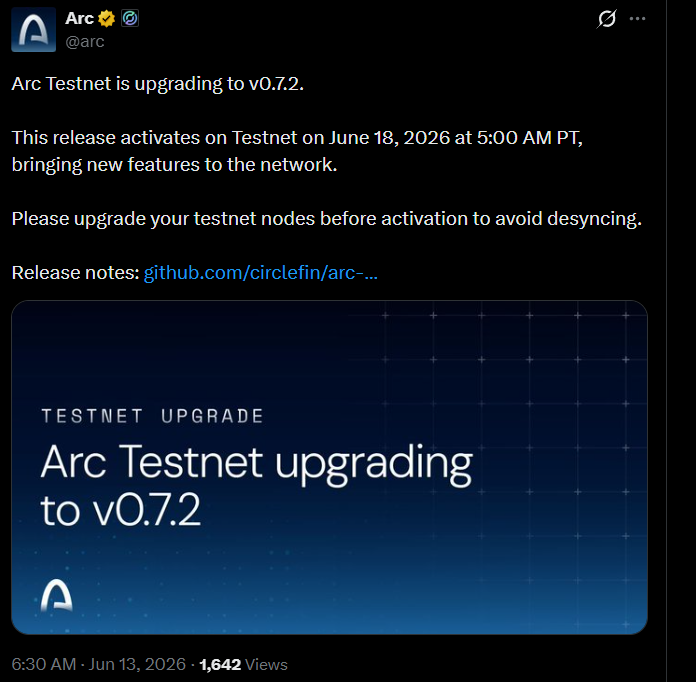 source: Official X
Why This Arc Testnet Upgrade Matters
Arc isn't just another Layer-1. It's Circle's own blockchain — the same company behind USDC — built specifically as a stablecoin-native "Economic OS" designed for internet finance, tokenized assets, and onchain markets.
Since its public testnet launched in October 2025, it has onboarded over 100 institutional partners, including names like BlackRock, Visa, and AWS. That partner list alone places this in a different category from most testnet-stage projects.
Each upgrade brings one step closer to a mainnet launch that institutional players are already positioned for — and the v0.7.2 activation is part of that forward momentum.
Key Technical Details of v0.7.2
While the release notes currently show minor sync commits, the official announcement confirms that new features are being introduced — though full feature documentation may expand as activation approaches.
What Makes Arc Different From Other L1s
Most Layer-1 blockchains are built as general-purpose networks. The blockchain is purpose-built around stablecoins and regulated finance, making it EVM-compatible while prioritizing:
-
Enterprise-grade value transfer
-
Privacy-preserving transactions
-
Onchain markets for tokenized assets
This design focus — backed by Circle's regulatory standing and USDC's market dominance — positions the Blockchain as a serious contender for institutional DeFi infrastructure once mainnet goes live.
Source: Wu Blockchain X
What Node Operators Must Do Before June 18
If you're running a testnet node on Arc, the official guidance is straightforward but time-sensitive:
-
Check your current node version against v0.7.2
-
Pull the latest release from the Arc Node GitHub repository
-
Complete the upgrading before 5:00 AM PT on June 18, 2026
-
Verify sync status post-upgrade to confirm you're aligned with the network
Failing to upgrades before activation will result in your node desyncing from the network — meaning you'll be running on an incompatible chain state until you manually update.
The community response so far has been bullish, with testnet participants expressing eagerness to test the new features going live with the upgrade.
What to Watch After the Upgrade Activates
The v0.7.2 is a milestone, but here's what matters next for traders and investors tracking Arc:
-
Feature documentation expansion: The release notes are sparse now; expect more detail to emerge as June 18 approaches or post-activation
-
Mainnet timeline signals: Every stable testnet upgrade narrows the gap to mainnet launch; watch for any official Arc mainnet date announcements
-
Institutional partner activity: With BlackRock and Visa already involved, any post-upgrade announcements from partners could move sentiment fast
-
USDC ecosystem plays: Arc's success is directly tied to Circle's broader ecosystem; any USDC market developments around this date are worth watching
Conclusion
The v0.7.2 on June 18 is a technical checkpoint, but it carries strategic weight given the institutional roster already behind this network. The operators have a clear deadline and a clear action — upgrade before 5:00 AM PT or face desync.
For the broader Crypto market, this is quietly building while others are talking. With BlackRock, Visa, and AWS in the partner mix and a mainnet still ahead, each activation is a signal worth tracking.
Disclaimer: This article is for informational purposes only and does not constitute financial or investment advice. Cryptocurrency investments carry significant risk. Always conduct your own research (DYOR) before making any financial decisions. CoinGabbar is not responsible for any losses incurred based on information provided in this article.


You May Also Like

SpaceX Becomes Binance’s Second Most-Traded Product Amid Massive Surge

CNN's Abby Phillip trips up GOP insider Scott Jennings with his own Iran words

A quiet transformation is reshaping modern finance



