Bitcoin derivatives traders are moving back into the market after an eight-month deleveraging phase, according to CryptoQuant analyst Darkfost, with Binance futuresBitcoin derivatives traders are moving back into the market after an eight-month deleveraging phase, according to CryptoQuant analyst Darkfost, with Binance futures

Bitcoin Traders Step Back In After Longest Deleveraging Since 2022

2026/05/23 09:00
3 min read
For feedback or concerns regarding this content, please contact us at crypto.news@mexc.com

Bitcoin derivatives traders are moving back into the market after an eight-month deleveraging phase, according to CryptoQuant analyst Darkfost, with Binance futures open interest now back above its 180-day moving average. The shift suggests risk appetite is returning after one of the longest reductions in leveraged exposure since the 2022 bear market.

Bitcoin Traders Are Returning

Darkfost said the deleveraging period began after the October 10 event, as Bitcoin’s correction coincided with a worsening global macroeconomic and geopolitical backdrop. In that environment, traders reduced exposure across derivatives markets, with Binance futures activity showing a sustained contraction.

“Since the October 10 event, Bitcoin has gone through a prolonged deleveraging phase across derivatives markets, represented here through Binance futures activity,” Darkfost wrote. “Following the October 10 event, combined with the deterioration in the global macroeconomic and geopolitical backdrop, traders largely opted to reduce risk. This deleveraging phase on Binance lasted roughly 8 months.”
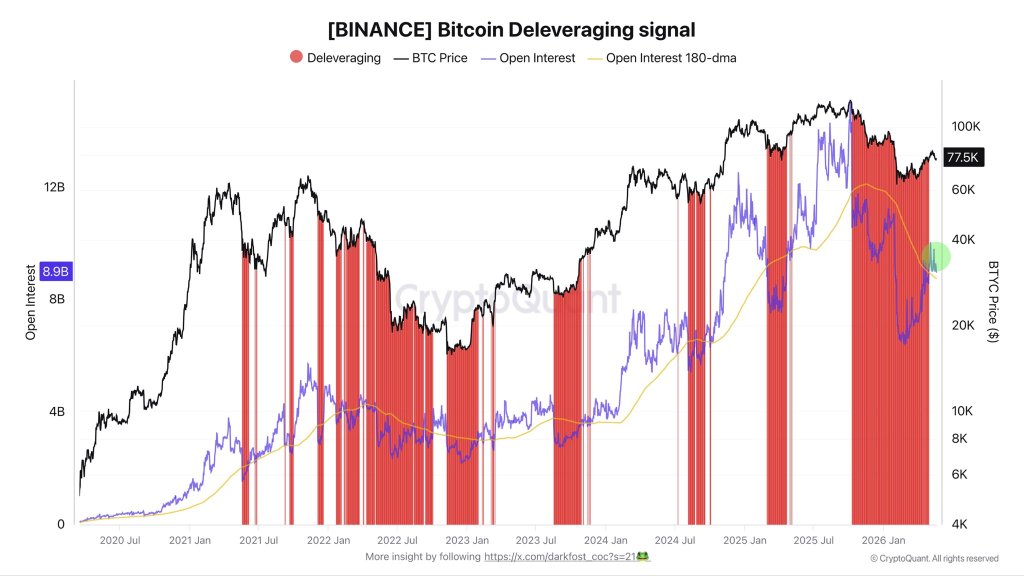
Bitcoin Deleveraging Signal

The analyst’s framework identifies deleveraging periods when open interest falls below its 180-day moving average. In market terms, that suggests futures activity is declining as corrections force liquidations, position closures and a broader reduction in investor exposure. For Bitcoin, the latest stretch was notable not only for its duration, but for how closely it resembled the setup seen in 2022 before the FTX collapse triggered another wave of liquidations.

The turning point appears to have emerged in early May. Binance open interest has risen from $6.4 billion in March to roughly $8.96 billion, Darkfost said, moving back above its 180-day average of about $8.75 billion. That crossover matters because it signals that derivatives activity is no longer in contraction relative to its medium-term trend.

“Since early May, however, the trend appears to be shifting,” the analyst wrote. “Binance Open Interest has risen from $6.4B in March to around $8.96B today, moving back above its 180 day average currently sitting near $8.75B. This effectively signals the end of the deleveraging period.”

The return of futures positioning has likely reinforced Bitcoin’s rebound from its corrective phase, according to the analyst. As open interest rises, more traders are deploying capital into directional and leveraged strategies, adding liquidity and potentially amplifying price moves. In this case, Darkfost argued that the renewed participation has “clearly contributed to the ongoing upward correction.”

Still, the analyst stopped short of describing the move as a durable recovery. The distinction is important. A rise in open interest can mark renewed confidence, but it can also reflect short-term speculative positioning after a sharp drawdown. Darkfost framed the current move as a rebound trade rather than confirmation that Bitcoin has fully exited the pressure that began in October.

“Despite a macro environment that has continued to deteriorate, Bitcoin’s sharp correction attracted more speculative traders looking to play a rebound,” he wrote. “That said, this trend remains highly fragile, and these traders could exit just as quickly as they entered if BTC resumes the correction that started back in October.”

That fragility is the main risk in the setup. The same derivatives flows now supporting the rebound could reverse if spot momentum weakens or macro conditions deteriorate further. In that scenario, recently added leverage would become a source of downside pressure rather than support, especially if traders who entered for a rebound move are forced to unwind quickly.

At press time, BTC traded at $77,479.
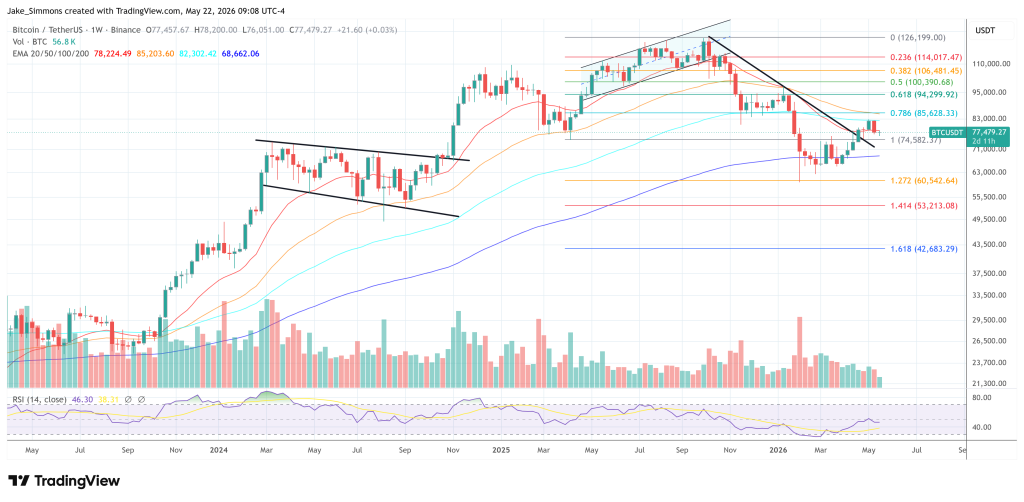
Bitcoin price chart

SPACEX(PRE) Launchpad Is Live

SPACEX(PRE) Launchpad Is LiveSPACEX(PRE) Launchpad Is Live

Start with $100 to share 6,000 SPACEX(PRE)

Disclaimer: The articles reposted on this site are sourced from public platforms and are provided for informational purposes only. They do not necessarily reflect the views of MEXC. All rights remain with the original authors. If you believe any content infringes on third-party rights, please contact crypto.news@mexc.com for removal. MEXC makes no guarantees regarding the accuracy, completeness, or timeliness of the content and is not responsible for any actions taken based on the information provided. The content does not constitute financial, legal, or other professional advice, nor should it be considered a recommendation or endorsement by MEXC.

You May Also Like

Music body ICMP laments “wilful” theft of artists’ work

Music body ICMP laments “wilful” theft of artists’ work

The post Music body ICMP laments “wilful” theft of artists’ work appeared on BitcoinEthereumNews.com. A major music industry group, ICMP, has lamented the use of artists’ work by AI companies, calling them guilty of “wilful” copyright infringement, as the battle between the tech firms and the arts industry continues. The Brussels-based group known as the International Confederation of Music Publishers (ICMP) comprises major record labels and other music industry professionals. Their voice adds to many others within the arts industry that have expressed displeasure at AI firms for using their creative work to train their systems without permission. ICMP accuses AI firms of deliberate copyright infringement ICMP director general John Phelan told AFP that big tech firms and AI-specific companies were involved in what he termed “the largest copyright infringement exercise that has been seen.” He cited the likes of OpenAI, Suno, Udio, and Mistral as some of the culprits. The ICMP carried out an investigation for nearly two years to ascertain how generative AI firms were using material by creatives to enrich themselves. The Brussels-based group is one of a number of industry bodies that span across news media and publishing to target the fast-growing AI sector over its use of content without paying any royalties. Suno and Udio, who are AI music generators, can produce tracks with voices, melodies, and musical styles that echo those of the original artists such as the Beatles, Depeche Mode, Mariah Carey, and the Beach boys. “What is legal or illegal is how the technologies are used. That means the corporate decisions made by the chief executives of companies matter immensely and should comply with the law,” Phelan told AFP. “What we see is they are engaged in wilful, commercial-scale copyright infringement.” Phelan. In June last year, a US trade group, the Recording Industry Association of America, filed a lawsuit against Suno and Udio. However, an exception…
Share
BitcoinEthereumNews2025/09/18 04:41
New Senate Secretary Jose Luis Montales and his ties with the Cayetanos

New Senate Secretary Jose Luis Montales and his ties with the Cayetanos

UNDERSECRETARY. Foreign affairs Undersecretary Jose Luis G. Montales delivers the opening remarks and ,essage of foreign affairs Secretary Alan Peter Cayetano on
Share
Rappler2026/05/23 10:35
Best Mobile User Retention Tools in 2026

Best Mobile User Retention Tools in 2026

Often, mobile apps lose their customers because the latter no longer visit them. Retention should be related to the behavioral signals. In this case, mobile tools
Share
Fintechzoom2026/04/02 18:06

No Chart Skills? Still Profit

No Chart Skills? Still ProfitNo Chart Skills? Still Profit

Copy top traders in 3s with auto trading!



