

Dollar Plunges to 12-Week Low Following Dismal Employment Data
Quick Summary
- The greenback is experiencing its steepest weekly decline since early April, falling approximately 0.7% over the week
- June employment figures showed only 57,000 new jobs added, significantly below the anticipated 110,000
- Federal Reserve rate hike probability for September dropped from approximately 64% to between 35–52%
- The yen experienced relief, recovering from a four-decade low of 162.84 against the dollar
- Japanese officials signaled readiness to intervene in currency markets if necessary
The greenback is experiencing its most significant weekly decline in almost three months following lackluster June employment data that substantially dampened expectations for Federal Reserve monetary tightening.
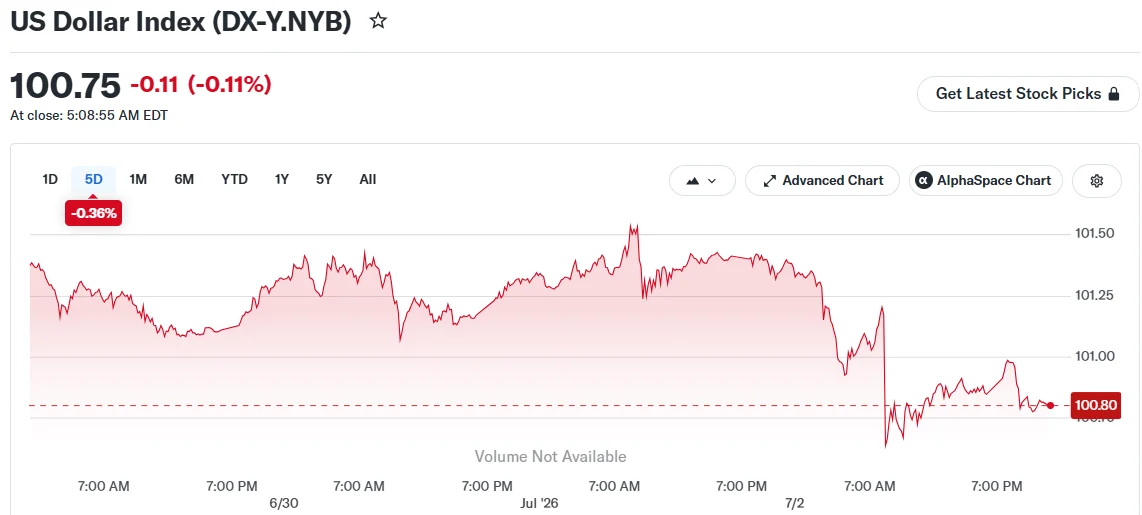 US Dollar Index (DX-Y.NYB)
June employment growth registered a mere 57,000 new positions. This figure fell dramatically short of the 110,000 consensus estimate among economists. Additionally, employment numbers for the preceding two months underwent downward revisions.
The workforce participation rate declined to 61.5%, marking its lowest point in over five years. Market participants immediately recalibrated their expectations regarding the Federal Reserve’s near-term monetary policy trajectory.
Prior to the data release, financial markets had been anticipating approximately a 64% probability of a September rate increase. Following the employment report, that likelihood tumbled to a range of 35% to 52%, based on CME FedWatch and LSEG calculations.
U.S. government bond yields retreated as well. Two-year Treasury note yields, which respond sensitively to interest rate outlook shifts, ended a three-session advance with a four basis-point decline.
The dollar index, measuring the currency against a collection of major global currencies, decreased roughly 0.3% to 100.68 on Friday. For the full week, it declined approximately 0.7%, representing the largest weekly loss since early April.
Global Currency Movements
The euro advanced to approximately $1.1472, approaching a two-week peak, and is positioned for a weekly increase of around 0.6%. Sterling strengthened to $1.3380, heading toward a weekly advance of 1.2% — its strongest performance in nearly three months.
The Australian dollar climbed to $0.6935, poised to end a four-week decline. The New Zealand dollar posted approximately 1.2% gains for the week.
Karl Steiner, chief analyst at SEB, noted the disappointing data aligned with his team’s forecast for eventual dollar weakness. He suggested further downside potential remains.
Yen Under Scrutiny
The Japanese yen found some respite this week, strengthening past 161 per dollar after touching a four-decade nadir of 162.84 on Thursday.
Japanese Finance Minister Satsuki Katayama stated on Friday that Tokyo maintains regular communication with Washington regarding currency matters and remains prepared to take action. Chief Cabinet Secretary Minoru Kihara emphasized officials were tracking markets with heightened vigilance.
Market participants are now monitoring for potential intervention, particularly during reduced liquidity conditions with U.S. markets shuttered for Independence Day observances.
Tony Sycamore, market strategist at IG, suggested 162.83 appears to represent a near-term ceiling for dollar-yen. He indicated the currency pair’s future direction will depend substantially on forthcoming U.S. economic releases and Japanese government bond market dynamics.
The post Dollar Plunges to 12-Week Low Following Dismal Employment Data appeared first on Blockonomi.


You May Also Like

Inside the Romualdez-linked P425-M Connecticut property

Social Media Buzz: Why Variant Fund’s Retweet Matters — Here’s What Changes


