

Best DeFi APIs in 2026: Developer Guide and Comparison
DeFi data is messy by default. A single Aave deposit spans approvals, contract calls, and receipt tokens. DeFi APIs turn that raw activity into structured, queryable answers. The best ones interpret positions, not just transactions.
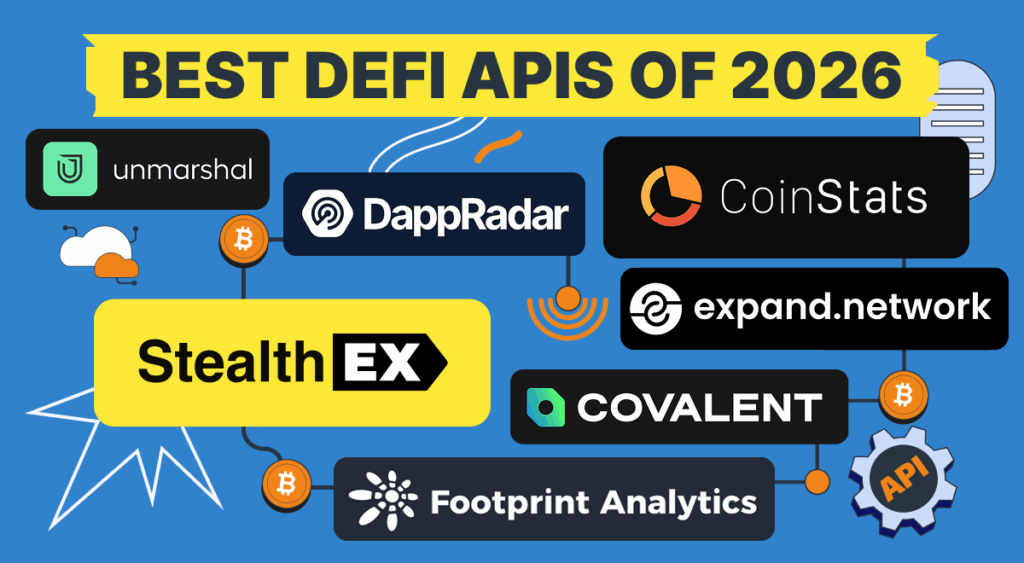
This guide ranks six DeFi APIs for 2026. Each one is mapped to the job it does best. We also cover the execution layer most data guides skip.
How to Choose the Best DeFi API
Position interpretation beats raw logs.
Anyone can serve event logs. Fewer APIs can tell you what a wallet actually holds. Staked tokens, LP shares, and lending collateral need decoding. APIs that resolve positions save weeks of indexer work.
Coverage should match where value lives.
Twenty well-indexed chains beat eighty shallow ones. Check protocol depth, not just chain count. For chain-specific picks, see our Solana API providers guide. The same logic applies to every ecosystem.
Pricing models shape your roadmap.
Free tiers vary widely in what they include. Credit-based plans scale better than hard call caps. We compared entry plans in our free crypto API comparison. Factor in the upgrade path early.
The Execution Layer: StealthEX
DeFi APIs deliver data: positions, balances, protocol metrics. At some point, users want to act on that data. Something has to execute the swap. That step is the execution layer, and it’s where StealthEX sits.
Our instant exchange API embeds non-custodial swaps into crypto products. Coverage spans 2,000+ cryptocurrencies and 100+ fiat currencies. Swaps run in fixed-rate and floating-rate mode. Floating rates match the market at execution; fixed rates lock the received amount.
The user experience stays light. No accounts are required, and no mandatory KYC applies to standard swaps. The average swap completes in under 15 minutes. Wallets, dashboards, aggregators, and trading terminals integrate it in hours.
The pricing model removes the usual friction. Integration is free, with no subscriptions or call caps. Partners set a commission between 0 and 0.5 percent per swap, with revenue sharing. White-label options cover fully branded experiences.
If your product only reads DeFi data, the six APIs below cover everything. If users should act on that data, pair one with StealthEX. One integration turns a read-only product into an actionable one.
The Best DeFi APIs of 2026
1. CoinStats Wallet API: All-in-One DeFi Data Layer
CoinStats Wallet API fits most DeFi data use cases. Pass a wallet address and get balances, transactions, and DeFi positions. Positions resolve automatically across 10,000+ protocols. No per-protocol integration work is needed.
Coverage spans 120+ blockchains through one endpoint format. The response schema is identical on every chain. Staked assets, LP shares, and lending collateral arrive decoded. The same infrastructure powers an app with 1M monthly users.
CoinStats API bundles market data behind the same key. Prices cover 100,000+ coins across 200+ exchanges. Portfolio analytics and token security for EVM chains round it out. The formula: market data + wallets + DeFi + portfolio analytics + token security.
CoinStats MCP Server exposes the same data as callable tools. AI agents on Claude or Cursor can query DeFi positions directly. Pricing is credit-based with a free tier, no card required. A deeper endpoint breakdown sits in this DeFi APIs guide.
Snapshot:
- DeFi positions auto-detected across 10,000+ protocols.
- 120+ blockchains in one response schema.
- Decoded staking, liquidity, and lending positions.
- Market data for 100,000+ coins and 200+ exchanges.
- Token security checks on EVM chains.
- MCP Server for AI agents and LLM apps.
- Credit-based free tier at signup.
Best Suited For: Most DeFi data use cases. Portfolio trackers, DeFi dashboards, tax tools, and AI-powered assistants needing positions plus market data.
2. Covalent (GoldRush): Granular Onchain Data
Covalent indexes raw blockchain activity under its GoldRush brand. The API exposes event logs, balances, and full transaction histories. That log-level depth suits protocol analytics and custom DeFi metrics. Chains share one schema, so multi-chain queries stay uniform.
Coverage reaches 100+ networks. SDKs ship for TypeScript, Python, and Go. A streaming API delivers sub-second updates for live dashboards. An MCP server supports AI coding agents.
The tradeoff is interpretation. GoldRush returns what happened onchain, not what a position means. Turning logs into staked balances or LP values is your job. Teams wanting decoded positions should look at entries one and six.
Snapshot:
- 100+ blockchains in one schema.
- Event logs, balances, and transaction histories.
- Streaming API with sub-second updates.
- SDKs in TypeScript, Python, and Go.
- MCP server for AI coding agents.
Best Suited For: Protocol teams and analytics builders working from raw, log-level onchain data.
3. Expand Network: Unified DeFi Endpoints With Execution
Expand Network by Blockdaemon unifies DeFi protocols behind one API. Around 170 endpoints cover DEXs, lending, bridges, yield aggregators, and oracles. The API spans EVM and non-EVM chains alike. Data and transaction endpoints sit side by side.
Execution is the differentiator. Apps can quote a swap, then submit it through the same interface. Lending actions like deposits and withdrawals work the same way. The model stays non-custodial, with end users signing every transaction.
The tradeoff is wallet-level breadth. Expand Network is organized around protocols, not portfolios. Aggregating one wallet’s full DeFi footprint takes extra assembly work.
Snapshot:
- 170+ endpoints across DeFi primitives.
- DEX, lending, bridge, oracle, and yield coverage.
- Data plus non-custodial transaction execution.
- EVM and non-EVM chain support.
Best Suited For: Trading systems and institutional tools that transact on DeFi protocols, not just read them.
4. Footprint Analytics: DeFi Metrics and Research Data
Footprint Analytics abstracts raw chains into structured, queryable tables. Its Data API serves DeFi and GameFi metrics across 30+ chains. Both raw records and pre-computed statistics are available. SQL access complements the REST endpoints.
The platform leans toward research and dashboards. No-code charting sits next to the API for quick exploration. Teams can prototype a metric visually, then productionize it via API.
The tradeoff is real-time wallet work. Footprint Analytics is built for metrics, not live portfolio rendering. Aggregate TVL trends fit better than per-user position lookups.
Snapshot:
- Structured DeFi tables across 30+ chains.
- Raw records plus pre-computed metrics.
- SQL and REST access in one platform.
- No-code dashboards for fast prototyping.
- Free tier with entry plans from $20 per month.
Best Suited For: Analysts and data teams building DeFi research products and metric dashboards.
5. DappRadar API: Dapp Rankings and Usage Data
DappRadar tracks decentralized applications across 90+ chains. The API exposes dapp-level metrics: active wallets, transactions, volume, and TVL. A database of 250,000+ smart contracts maps activity to named dapps. Scam alerts flag unlisted or suspicious contracts.
The data answers a distinct question: which dapps are winning? Wallets like OKX and browsers like Opera use it for discovery. Categories span DeFi, gaming, and NFT marketplaces.
The tradeoff is granularity. DappRadar API measures dapps, not individual wallets or positions. It complements a wallet data API rather than replacing one.
Snapshot:
- Dapp metrics across 90+ chains.
- Active wallets, transactions, volume, and TVL.
- 250,000+ smart contract database.
- Scam alerts for contract safety.
- Used by OKX Wallet, Opera, and Blockchain.com.
Best Suited For: Discovery surfaces, wallets, and research tools ranking dapps by real usage.
6. Unmarshal: Decoded Wallet and Protocol Data
Unmarshal runs a decentralized network of blockchain indexers. APIs cover token balances, decoded transactions, and protocol positions. Lending and borrowing positions resolve through its protocol engine. Responses typically land in under 250 milliseconds.
Transaction decoding is a highlight. Each transaction returns with a one-line, human-readable description. Wallet notifications and websockets support real-time products. Coverage spans 50+ chains, mostly EVM networks.
The tradeoff is scope outside EVM. Non-EVM coverage and exchange data stay limited. Protocol position depth varies by chain.
Snapshot:
- Token balances and decoded transactions.
- Protocol positions for lending and borrowing.
- Wallet notifications and websocket streams.
- 50+ chains, primarily EVM.
- Sub-250ms response targets.
Best Suited For: EVM-focused wallets and dashboards wanting decoded transactions with real-time alerts.
DeFi APIs Comparison: Matching Tools to Jobs
Best Overall DeFi Data API
CoinStats Wallet API combines decoded positions, market data, and portfolio analytics. One key covers most DeFi data needs, AI agents included.
Best for Raw Onchain Depth
Covalent fits teams that want log-level data in one schema. Interpretation stays on your side, and flexibility stays high.
Best for Protocol Execution
Expand Network pairs DeFi data with non-custodial transaction endpoints. Trading infrastructure benefits most.
Best for Research and Metrics
Footprint Analytics turns chains into queryable tables. Analysts get SQL, dashboards, and an API in one place.
Best for Dapp Intelligence
DappRadar API ranks dapps by usage, volume, and TVL. Discovery products gain instant context.
Best for Decoded EVM Data
Unmarshal delivers readable transactions and protocol positions with low latency. EVM-first products fit best.
Which DeFi API Should You Choose?
- Choose CoinStats Wallet API for the all-in-one default: Decoded DeFi positions, wallet data, market prices, and MCP support ship together. That breadth fits most builds.
- Choose Covalent when raw logs matter: Protocol analytics and custom metrics benefit from event-level access.
- Choose Expand Network to transact: Swaps, lending actions, and bridge calls run through unified endpoints.
- Choose Footprint Analytics for research: Structured tables and SQL fit analyst workflows.
- Choose DappRadar API for dapp context: Usage rankings and contract safety data enrich discovery products.
- Choose Unmarshal for decoded EVM feeds: Readable transactions and notifications suit real-time wallets.
Conclusion
DeFi APIs split into clear layers. Data APIs decode what wallets and protocols are doing. Analytics APIs measure the market above them. Execution APIs let users act.
For most builds, the data layer comes first. CoinStats Wallet API covers that layer broadly; the others serve sharper niches. StealthEX adds the execution layer when your product is ready.
Ready to put swaps inside your wallet, dashboard, or terminal? Integrate StealthEX crypto exchange through its Affiliate Program and earn from every transaction.
Make sure to follow StealthEX on Medium, X, Telegram, YouTube, and Publish0x to stay updated about the latest news on StealthEX and the rest of the crypto world.
Don’t forget to do your own research before buying any crypto. The views and opinions expressed in this article are solely those of the author.
CoinStats crypto exchange crypto exchange API DeFi exchange API StealthEXThe post Best DeFi APIs in 2026: Developer Guide and Comparison first appeared on StealthEX.


You May Also Like

LIST: Bayanihan initiatives amid soaring oil prices

Crypto Hack: Drift Protocol Drained Over $200M in Private Key Breach

Metaplanet Stock Passes MARA to Become Third-Largest BTC Holder — Stock Slips Anyway



