

Must Read
Senator Ronald dela Rosa walks from his office to talk to journalists at the Senate on May 12, 2026.Senator Ronald dela Rosa walks from his office to talk to journalists at the Senate on May 12, 2026.
Mao Aplasca: Retired police chief, Davaoeño, mistah to Ronald dela Rosa
For feedback or concerns regarding this content, please contact us at crypto.news@mexc.com
MANILA, Philippines — After months of absence from the Senate, one of Senator Ronald dela Rosa’s first official acts was to nominate his mistah and fellow former police general Mao Aplasca as Senate Sergeant-at-Arms.
It would not be the first time Dela Rosa, who led the Philippine National Police (PNP) at the start of former president Rodrigo Duterte’s drug war, had vouched for his Philippine Military Academy (PMA) classmate.
“I knew personally General Aplasca since we were both members of Philippine Military Academy Class of ’86, but unluckily he graduated in 1987,” said Dela Rosa in July 2025, at the opening of the 20th Congress.
Luck was quick to find Aplasca in the PNP, at least after his mistah was appointed top cop in 2016, and members of the 1986 class quickly became the ruling class in the PNP. Despite being turned back – or “delayed by a year,” in PMA parlance – he went on to hold key posts until he retired in 2019 as a three-star general.
Ties run deep
Aplasca and Dela Rosa’s ties run deep and close to the heart.
Inside the academy, the senator recalled in 2025, Aplasca “helped [him] graduate” and “surpass [our] plebe-hood” by just being around.
“We were both coming from the provinces of Davao and we both… didn’t know how to speak Tagalog when we were in PMA,” Dela Rosa said in endorsing his mistah as head of Senate security in 2025.
Four decades later, the two Davaoeños’ ties are at the center of what has been, thus far, an unprecedented three days of drama, action, and even some comedy in the most august halls of the Senate.
Since his swift return as chief of security for the Senate this week, Aplasca has watched over two lockdowns, a firefight with operatives from government, and the early morning “escape” of his mistah who has an arrest warrant issued against him by the International Criminal Court (ICC) over his role in the Duterte drug war.
Aplasca has been suspended by the Ombudsman.
‘We’re arresting someone’
On the evening of Wednesday, May 13, Dela Rosa went live on Facebook and called on the public’s support as he claimed that both the National Bureau of Investigation (NBI) and the police would come to arrest him.
Around 7 pm, Aplasca told reporters that the Senate would be locked down and that they had five minutes to leave the Senate building, if they choose to do so. He’d told reporters that they were going to execute an arrest, but did not give more details.
A chasearound triggered by a sighting of Dela Rosa and some herding by Aplasca’s Office of the Senate Sergeant-at-Arms (OSAA) followed, and it was 7:44 pm.
At this point, Aplasca gathered both OSAA personnel and Senate perimeter forces – members of the Police Security and Protection Group and Marines – in front of the second-floor elevator.
The Marines were in standard gear, including bulletproof vests and helmets, and were carrying firearms. OSAA personnel, in blue-gray polo barongs, were wearing protective vests and carrying their firearms.
Aplasca, also wearing a protective vest and carrying what looked like a CZ Scorpion Evo 3, led the steady, calm walk of OSAA personnel, Marines, and police to the right side of the building’s second floor, which leads to the connecting bridge between the rented Senate building and the main GSIS building.
A firefight soon followed, with journalists either rushing out of the building or taking cover in the press office area.
The NBI, reportedly tasked with securing the GSIS side of the compound, and Malacañang later said it was the OSAA, and Aplasca specifically, who fired the first warning shot, prompting the NBI to fire its own warning shot.
Aplasca’s version
Over DZRH on Friday, May 15, Aplasca said the firing of a warning shot was part of the OSAA’s rules of engagement. He said OSAA personnel could not allow themselves to be hurt and had to insist that the NBI stand down and put down their arms.
Aplasca claimed that the NBI agents refused to put down their guns.
This is Aplasca’s version of events and his reasoning for his actions, as told to reporters the day after on Thursday, May 14: his decision to round up the Senate’s perimeter security forces and the OSAA was not meant to shield Dela Rosa from a supposed arrest, but was “part of implementing the security measures of the Senate.”
Aplasca said senators were concerned for their safety after receiving calls that allegedly urged them to leave the Senate because something big was about to happen.
“Naalarma na rin kami… dahil sa mga reports, eh, naghanda po kami (We were alarmed too, so we prepared),” he said.
“Hindi po kami pupunta doon na hindi kami nakahanda sa giyera (We would not go there without preparing for a war),” he added.
Their assessment, based on movements captured by the Senate’s CCTV cameras, was that the armed personnel who turned out to be NBI, were a threat.
As Aplasca was narrating his version of the night’s events, it turned out the area had already been processed. Media were later allowed closer to the scene of the confrontation, but the glass windows had already been barricaded, any casings removed, and markings left by Scene of the Crime Operatives cleared.
Asked what he thought about the May 13 incident — unprecedented in the relatively young history of the current Philippine Senate — Aplasca chose not to share his thoughts or feelings, but instead spoke about his surprise at being reinstated as Senate Sergeant-at-Arms.
Multiple stints
Both newly-elected Senate President Alan Peter Cayetano and Dela Rosa invited him to come over to the Senate from the Commission on Appointments, where he served as head of security.
He did not speak to Cayetano and had a quick chat with Dela Rosa, who told him to wait a little. On the Senate floor, senators were already deliberating his appointment as acting Senate Sergeant-at-Arms.
According to public government documents and news reports, Aplasca has served as a senior official in Batangas, the Police Regional Office in Davao, before serving under Police Regional Office VI in Western Visayas.
His stints as a star-ranked officer all took place between 2016 and 2019, or the first half of the Duterte administration and his bloody drug war.
He earned his first star and served as director of the PNP’s Aviation Security Group from 2016 to 2017, during which he was tasked with resolving the so-called “tanim-bala” controversy, where passengers would be caught — and possibly face charges — after bullets were found in their luggage.
Aplasca was then appointed regional police chief for Calabarzon before going on to hold two key leadership roles in Camp Crame — as a two-star director of operations and three-star deputy chief of operations (DCO) before eventually retiring on August 22, 2019.
After retirement, Aplasca joined the Office for Transportation Security (OTS) under the Department of Transportation. He was later designated Sergeant-at-Arms of the House of Representatives in the 18th Congress. He resigned in 2021.
In 2022, he was first nominee for Avid Builders of Active Nation’s Citizenry Towards Empowered Philippines or Abante Pilipinas, which garnered 85,173 votes, or roughly 0.24% of voters who engaged in the party-list elections. The last party-list to secure a seat in the 2022 elections got around 236,929 votes.
In 2022, he returned to OTS by virtue of an appointment from President Ferdinand Marcos Jr. This time he was the office’s administrator and held the rank of undersecretary.
Aplasca found himself in hot water in 2023, when then-House speaker and presidential cousin Martin Romualdez called for his resignation following a scandal involving airport security personnel caught on CCTV swallowing $300 worth of bills allegedly stolen from a departing passenger. Aplasca quit in 2023.
He returned to government in 2025, as Senate Sergeant-at-Arms when the 20th Congress opened.
Bato’s ‘sacrifice’
Aplasca does not seem to be bothered by Dela Rosa’s early-morning escape nor is he concerned that this was seemingly not stopped or unable to be stopped — either by OSAA, or the police, or the Marines detailed to the Senate.
Instead, he is sad. “Malungkot nga po na umalis siya dito. Kasi dito, meron akong control para protektahan si Sen. Bato. Eh, sa labas, hindi ko alam kung anong mangyayari (I’m sad he left. Here, I have control to protect Senator Bato. Outside, I don’t know what could happen),” he told reporters on May 14.
He had already established a routine of sorts in the three nights Dela Rosa spent inside the Senate. At around 1 am, he’d make his way to wherever Dela Rosa was. “Binibisita ko po si Sen Bato as part of my job. Kung mayroong under protective custody, lalo na’t kaklase ko po siya sa PMA, eh part po ng aking duty na bisitahin si Sen Bato,” he said.
(I visit Senator dela Rosa as part of my job. If anyone is under protective custody, especially since he’s my classmate in the PMA, then it’s part of my duty to visit him.)
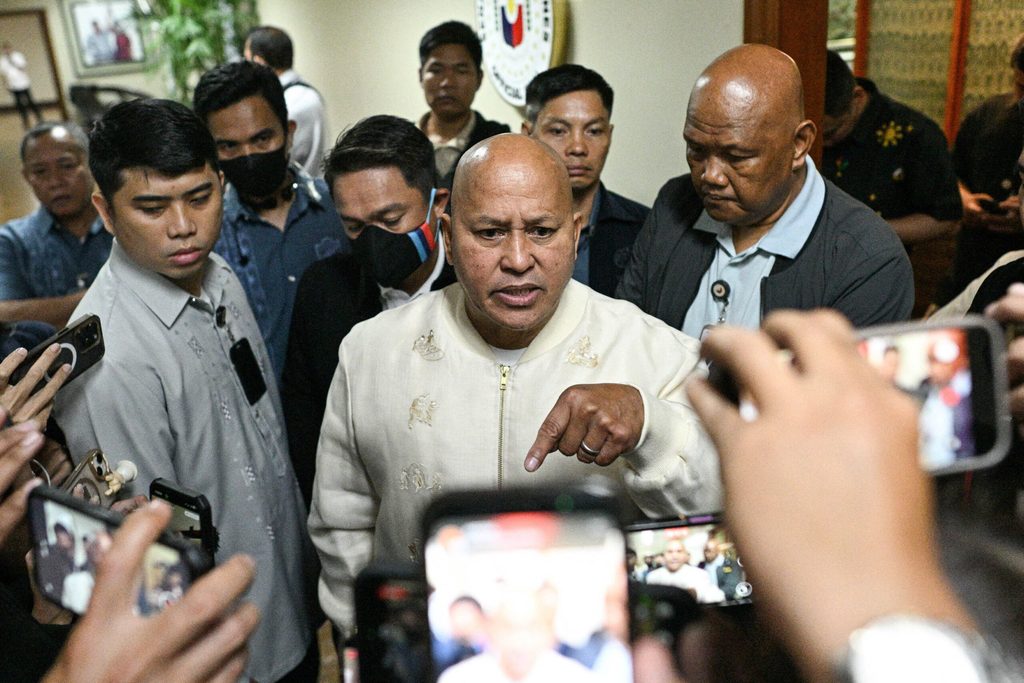 Senator Ronald dela Rosa walks from his office to talk to journalists at the Senate on May 12, 2026.
Dela Rosa had hunkered down in the Senate to avoid arrest stemming from an ICC warrant. It is not a formal protection codified in Philippine law, but a courtesy typically extended to members of the legislature, under which they are not arrested inside Senate premises — even if senators in the past, including those who opposed former president Duterte, were subject to the service of warrants inside the Senate.
From his visits and maybe through Dela Rosa’s repeated media interviews, Aplasca said he also felt sorry (“naawa,” in Fillipino) for his PMA classmate.
“Nakikita ko po talagang mabigat sa kanyang… Naririnig naman yung kanyang expression, ‘yung kanyang frustration na sinasabi niya na it’s quite a sacrifice,” said Aplasca. It was at this point in the brief interview with media that his voice cracked.
(You can see how heavy this is on him. You can hear his expressions, his frustration that it’s been quite a sacrifice.)
It’s a sentiment that echoes through some parts of the PMA alumni world — that it’s unfortunate to see these events transpire around a retired official who had devoted his entire life to uniformed service. That the service included Duterte’s bloody drug war is a detail that’s often left out of these discussions.
Aplasca said he was no longer in contact with Dela Rosa after that 1 am visit. Dela Rosa and his close ally and friend, the action star Senator Robin Padilla, also apparently exited the Senate premises with neither resistance nor fanfare.
“Ang report sa akin, from the parking, parang tuloy-tuloy, normal sila. Naglakad lang naman, sumakay, tuloy-tuloy lumabas,” said Aplasca, referring to Dela Rosa and Padilla’s actions leading up to their exit from the Senate in the wee hours of the morning on May 14.
(The report that reached me is that from the parking area, everything was normal. They walked, rode the vehicle, and left.)
Just like Bato
In the same way that Dela Rosa seems to believe he did no wrong in the drug war, Aplasca, in his public statements, maintained that his actions on May 13 were warranted.
He has said the NBI should have coordinated with the Senate their movements near the Senate building, even if it was inside GSIS. He has also stressed that the NBI agents were staying on the Senate side of the compound.
While he said they were prepared for “war,” he also told reporters he did not expect an actual firefight in the confrontation with the NBI.
On Friday, he told a radio program that the OSAA had so far been unable to find CCTV footage showing the movements of OSAA and Marines during the May 13 incident.
The same day, the Ombudsman ordered him preventively suspended for six months without pay. – Rappler.com


Disclaimer: The articles reposted on this site are sourced from public platforms and are provided for informational purposes only. They do not necessarily reflect the views of MEXC. All rights remain with the original authors. If you believe any content infringes on third-party rights, please contact crypto.news@mexc.com for removal. MEXC makes no guarantees regarding the accuracy, completeness, or timeliness of the content and is not responsible for any actions taken based on the information provided. The content does not constitute financial, legal, or other professional advice, nor should it be considered a recommendation or endorsement by MEXC.
You May Also Like

Spot CVD Chart Reveals Critical Bitcoin Support Levels as Institutional Orders Surge on April 2
BitcoinWorld Spot CVD Chart Reveals Critical Bitcoin Support Levels as Institutional Orders Surge on April 2 On April 2, 2025, at precisely 10:00 a.m. UTC, a detailed
Share
bitcoinworld2026/04/02 18:45

Bitcoin Exchange Supply Hits Lowest Level Since 2018 While Ethereum Supply Rises
Bitcoin Exchange Supply Falls to Lowest Level Since 2018 While Ethereum Supply Rises New blockchain data from Santiment reportedly shows that the amount of Bitc
Share
Hokanews2026/05/15 21:15

Top Weekly Crypto Gainers – Telcoin and AI Tokens Lead Market Surge in May 2026
Telcoin leads May 2026's top crypto gainers with a 76.21% surge as AI tokens like Sahara AI and Akash Network dominate the weekly leaderboard.
Share
Blockchainreporter2026/05/15 21:22



