RTS Link Singapore–JB (2026): Fares, Stations & Opening
The cross-border MRT that turns the Causeway into a five-minute ride.
The Johor Bahru–Singapore Rapid Transit System (RTS) Link is a 4 km cross-border MRT line connecting Woodlands North in Singapore to Bukit Chagar in Johor Bahru. Service is targeted to begin from December 2026, with one-way fares expected to land around S$5–S$7 (RM15.50–RM21.70). End-to-end journey time is about five minutes, plus a one-stop immigration clearance at the departure station, so no second queue after you arrive.
For the ~300,000 people who cross between Singapore and JB every day, this is the first cross-border MRT of its kind in Southeast Asia — built to replace the 3 AM alarm, the Causeway crawl, and the dual-checkpoint shuffle that turns a weekend into a project.
 Stay Up To Date:
– JB Food Guide 2026: 29 Best Places to Eat in JB
– Lotte Duty Free Korea: Exclusive Deals, K-Beauty Picks & What to Know
– Singapore Public Holiday 2026: Turn 11 Days Into 39 With Smart Leave Planning
 TL;DR
TL;DR
| Highlights | Details |
|---|---|
| Route | Woodlands North (SG)  Bukit Chagar (JB) Bukit Chagar (JB) |
| Distance | 4 km |
| Travel time | ~5 minutes one way |
| Opens | Targeted December 2026 (possible slip to early 2027) |
| Expected fare | S$5–S$7 (RM15.50–RM21.70) one way |
| Frequency | Every ~3.6 min at peak; off-peak TBC |
| Operating hours | Expected ~6 AM to midnight, daily (final hours TBC) |
| Capacity | Up to 10,000 passengers per hour, each direction |
| Clearance | Co-located: both immigrations at the departure station |
| Operator | RTS Operations (RTSO) — SMRT × Prasarana JV |
 Table of Contents
- What Is the RTS Link?
- When Will the RTS Link Open?
- How the RTS Link Works
- How Long Is the RTS Link Journey?
- How Much Will the RTS Link Cost?
- RTS Link vs Bus, Car and Causeway Crossing
- How Many People Will the RTS Link Carry?
- The Stations: Woodlands North and Bukit Chagar
- What to Do at Bukit Chagar
- How to Spend Smart in JB
- FAQ
What Is the RTS Link?

Image Credits: MRT Corp
The RTS Link is the Johor Bahru–Singapore Rapid Transit System, a dedicated 4 km cross-border MRT line linking Woodlands North in Singapore with Bukit Chagar in Johor Bahru. It’s not an extension of the Thomson-East Coast Line (TEL) or the KTM Intercity network. It’s a stand-alone shuttle built purely to move people across the Strait of Johor in minutes.
A few things worth knowing upfront:
- It’s driverless. Eight four-car trains, all automated, no driver cab.
- It’s a JV. Operated by RTS Operations Pte Ltd (RTSO), a joint venture between SMRT (Singapore) and Prasarana Malaysia.
- It’s purpose-built. The trains, signalling and stations were designed from scratch for this line. MOT confirms each train will carry more than 600 passengers.
- It’s short. The whole route is just 4 km, with one station at each end.
If you’ve used the TEL, the experience at Woodlands North will feel familiar. The difference is what happens after the train pulls in at the other end: you walk out into Johor Bahru.
When Will the RTS Link Open?
The RTS Link is targeted to begin passenger service by December 2026. That’s the date Singapore’s Parliament referenced in the May 2026 reading of the Cross-Border Railways Bill. Some reports have flagged a possible slip to early 2027 as systems testing progresses, so build a buffer into any trip you plan around opening week.
What’s been delivered so far:
- First train unveiled at the Singapore Rail Test Centre (SRTC) in Tuas on 30 June 2025, by Singapore’s Transport Minister and Malaysia’s Anthony Loke.
- Bukit Chagar station structural works largely completed by April 2026, with systems testing scheduled to begin from around September 2026.
- All eight trains are being manufactured by CRRC Zhuzhou Locomotive in China.
- System-wide works were about 56% complete when the first train was unveiled in June 2025.
The schedule is tight but the moving pieces are on the rails (literally). Day-one launches for projects this big rarely hit the published date, so don’t book your inaugural-ride trip until the line actually starts running.
How the RTS Link Works
The RTS Link works like a short, frequent shuttle MRT with all the border admin moved to the departure station. You tap in at Woodlands North, clear both Singapore and Malaysia immigration before you board, and walk straight out at Bukit Chagar with no second queue.
The Route — Woodlands North to Bukit Chagar
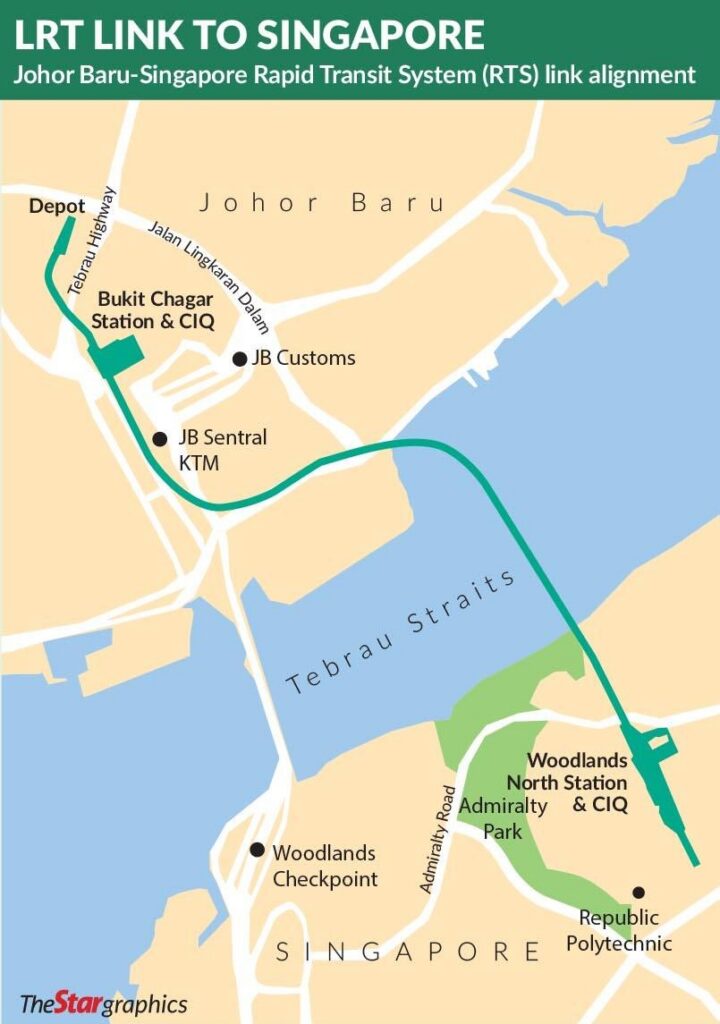
Image Credits: Land Transport Guru
The line runs north–south for 4 km, crossing the Strait of Johor on a dedicated rail viaduct (separate from the Causeway road bridge). Trains travel up to 80 km/h.
- Singapore end: Woodlands North MRT, an existing TEL interchange (the northern terminus of the line, opened in 2019).
- Malaysia end: Bukit Chagar, a new station built specifically for the RTS, sitting next to JB Sentral.
Co-Located Border Clearance and E-Gates
Both countries’ immigration counters are placed at the departure station. So if you’re starting in Singapore, you clear Singapore exit immigration and Malaysia entry immigration at Woodlands North before boarding. You arrive at Bukit Chagar already cleared and walk straight out.
The Bukit Chagar Integrated Immigration, Customs and Quarantine (ICQ) Complex has been built out, per Malaysia’s Home Ministry (Feb 2026), with:
- 100 AI-powered e-gates to handle peak flows
- About 7-second clearance per gate
- 18 baggage scanners and 10 security screening lanes
- Dedicated lanes for passengers travelling without check-in luggage
Woodlands North has its own ICA-run departure clearance area on the upper level and a Malaysian-managed arrival clearance area one level below, in the same building.
Frequency, Speed and Operating Hours
- Trains every 3.6 minutes at peak hours (per Malaysia’s MRT Corp)
- More spaced off-peak service (final timetable TBC by RTSO closer to launch)
- Expected to operate daily, roughly 6 AM to midnight (final hours TBC)
- Top speed around 80 km/h
- Service is automated end to end
In practice, you turn up, tap in, clear, board, and you’re in JB before your kopi would’ve cooled at a Causeway bus queue.
How Long Is the RTS Link Journey?
The RTS Link journey takes about 5 minutes from Woodlands North to Bukit Chagar, station to station. Door-to-door, it’ll feel longer once you add walking and the 7-second e-gate clearance, but you’re looking at roughly 15–20 minutes for the full crossing on a normal day, including immigration.
Compare that to the current options on a weekend morning:
- Bus 170 + walk + Causeway queues: anywhere from 60 to 180 minutes, depending on the line at Woodlands Checkpoint and BSI.
- Car via Causeway: 30 minutes on a smooth day, 3+ hours on a Friday night or public holiday Saturday.
- KTM Shuttle Tebrau train: ~5 minutes train time, but limited tickets and fixed slot — basically full out from the moment booking opens.
You can read the full breakdown of all three current options in our Train to JB Guide, which also covers the new JB–KL ETS service launched in December 2025.
How Much Will the RTS Link Cost?
The expected one-way fare is S$5–S$7 (RM15.50–RM21.70) per trip, based on Malaysian Transport Minister Anthony Loke’s February 2026 statements to the Malaysian press. Fares aren’t officially confirmed yet — RTSO will propose final rates in the second half of 2026, with both governments needing to sign off.
A few things to keep in mind:
- Symmetrical pricing: fares should work out to roughly the same amount whether you pay in SGD or MYR (matched at the prevailing exchange rate).
- Off-peak fares and season passes are planned for frequent cross-border commuters.
- The Malaysian government has flagged it’ll look into subsidised season passes for Malaysians who cross often for work or school. No similar subsidy has been announced on the Singapore side.
If you’re comparing this against the KTM Shuttle Tebrau today (around S$5 from Woodlands to JB Sentral and RM5 the other way (verify live on KTMB before booking), the RTS Link is in the same ballpark, just with dozens of departures a day instead of five and no advance booking gymnastics.
RTS Link vs Bus, Car and Causeway Crossing
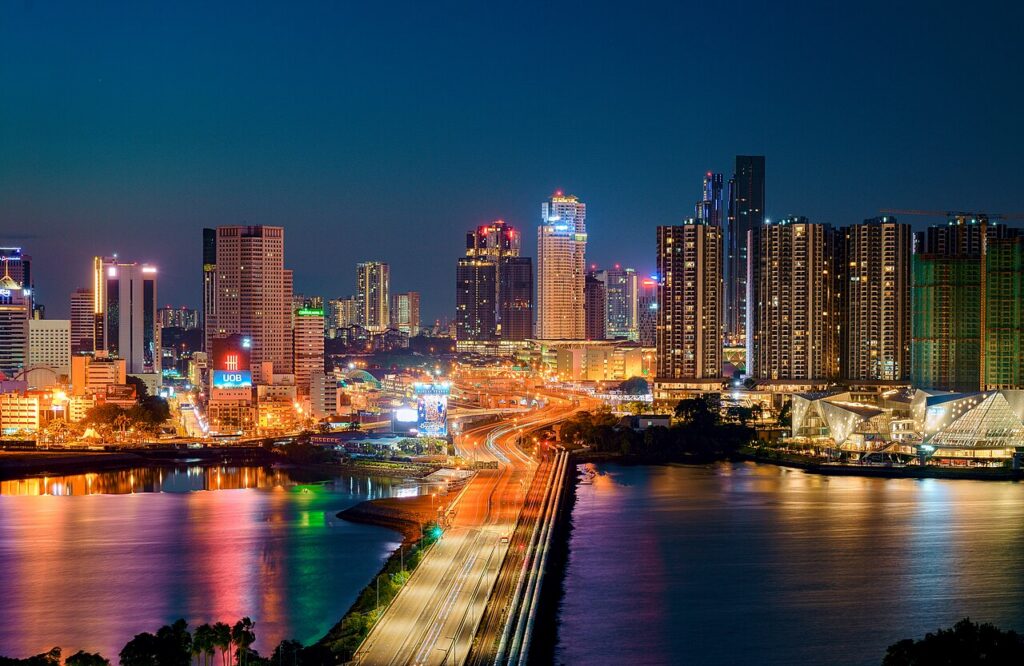
Image Credits: Wikipedia
The bus is cheap, the car is flexible, and the RTS Link is fast. Which one wins depends on your day, not the spec sheet.
| Option | Cross-border time (typical) | Cost per trip | Wait dependency | Best for |
|---|---|---|---|---|
| RTS Link | ~15–20 min door-to-door | S$5–S$7 (expected) | Frequent — every 3.6 min at peak | Day trips, predictable timing, no luggage |
| Bus 170 + walk | 60–180 min on a weekend | ~S$2.20 each way | Heavily traffic-dependent | Budget-only days, no rush |
| KTM Shuttle Tebrau | ~30 min station-to-station | ~S$5 / RM5 (verify live) | Fixed slot, books out fast | The one ticket you nailed weeks ago |
| Driving (Causeway) | 30 min smooth, 3+ hr on peak | Petrol + VEP + tolls | Causeway traffic | Big group, lots of haul, kids in tow |
| Cross-border coach | 60–120 min | ~S$10–S$25 | Schedule-fixed | One-shot KL or further trips |
Verdict: for a Singaporean day-tripping for food, shopping, or a quick haircut, the RTS Link replaces everything else from late 2026 / early 2027 onwards. Driving still wins if you’re hauling back two months of groceries from KSL, but for the standard weekend, it’s the train.
How Many People Will the RTS Link Carry?
The RTS Link is built to move up to 10,000 passengers per hour in each direction, with daily ridership starting at around 40,000 at launch and projected to grow to 140,000 as it matures.
Per-train numbers:
- Eight trains, four cars each
- Over 600 passengers per train (per Singapore’s Ministry of Transport)
- Designed to handle up to around 1,100 at crush load
- Driverless, with automated turnaround at both ends
MRT Corp (Malaysia) projects that the RTS Link will cut Causeway congestion by at least 35% at maturity. Long-term ridership is expected to grow toward 140,000 a day. So even if you stick to the bus, the line you’re queuing in should be visibly shorter.
The Stations: Woodlands North and Bukit Chagar
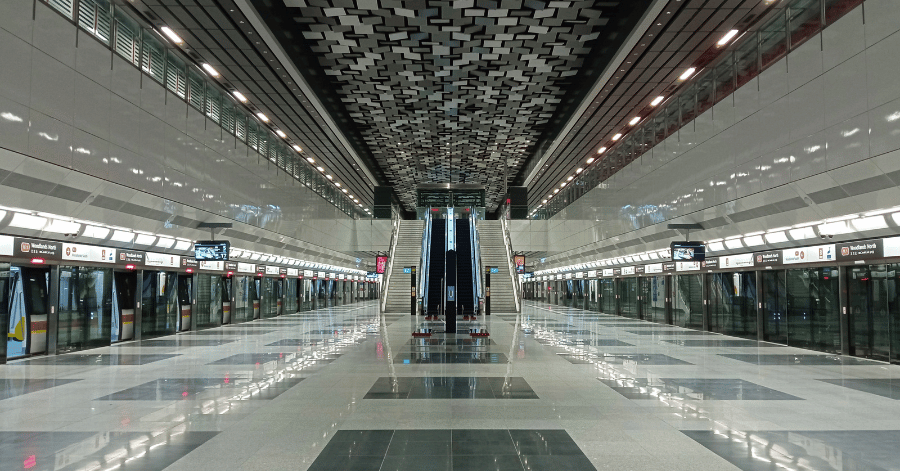
Image Credits: Wikipedia
The two stations sit at very different points on the map. Knowing what’s around each one saves you from planning a trip that ends with a 20-minute Grab ride you didn’t expect.
Woodlands North (Singapore)
- Where: TEL terminus, opened on 31 January 2020, on the north side of Republic Polytechnic.
- Connections: TEL all the way to Gardens by the Bay / Marina South, with interchanges at Caldecott (CCL), Stevens (DTL), Orchard (NSL), Outram Park (EWL/NEL).
- What’s nearby: Not much yet — this part of Woodlands is still developing. Plan to use it as a transit-only node, not a hangout.
The Woodlands North RTS facility has been built as part of the existing MRT station, with the departure-clearance levels stacked above the train platforms.
Bukit Chagar (Johor Bahru)
- Where: New station in central JB, directly adjacent to JB Sentral.
- Connections: 400-metre sheltered walkway straight to JB Sentral, where you can connect to the KTM Intercity services and the new JB–KL ETS (launched December 2025).
- What’s nearby: A lot. Komtar JBCC sits about 350 metres south of the station, City Square Mall is adjacent to JB Sentral, and the Arulmigu Sri Rajakaliamman Glass Temple is about 1.4 km northwest (15–20 minute walk).
This is the real win: you arrive in the middle of downtown JB. No 20-minute Grab, no walk along an expressway, no figuring out which bus stops where. You walk out, and you’re already there.
What to Do at Bukit Chagar
The best part about Bukit Chagar is that the whole JB city centre is walkable from the station. Most of downtown sits within a 10 to 15-minute walk.
What’s worth slotting in:
- City Square Mall: sits right next to JB Sentral. Solid for shopping, food courts, and pharmacy hauls. See our full City Square JB guide for what’s worth your time.
- Komtar JBCC: newer mall, 350 metres south of Bukit Chagar. International brands, food, cinemas.
- Jalan Tan Hiok Nee heritage lane: 10–15 minutes on foot. Kopitiams and old shophouse cafes. Pair with our breakfast in JB roundup for the must-try downtown spots.
- Arulmigu Sri Rajakaliamman Glass Temple: about 1.4 km northwest, a 15–20 minute walk. Free entry, photogenic if you’ve never seen it. Grab a bottle of water — there’s no shade on the way.
- Skyscape JB: observation deck on the 34th floor of Menara Jland with a glass sky bridge, if heights are your thing.
For full-day plans, the RTS doesn’t really stretch your time, so consider pairing it with one of these:
- Dim sum lunch: the city has a strong dim sum scene. See the dim sum in JB list.
- A mall day: Bukit Chagar is in walking distance of City Square and Komtar JBCC, but if you want the big-haul malls, you’ll need a 5–10 minute Grab to KSL City Mall (about 4.8 km away) or further out to Paradigm Mall, Mid Valley Southkey, or Mount Austin.
- The full city-centre roam: pair with our JB weekend getaway guide and the broader JB food guide for a day’s planning.
How to Spend Smart in JB
The RTS Link makes JB feel like a Saturday outing instead of a trip. That changes how you pay — and the cleanest setup for a SG day-tripper is straightforward.
1. Tap your YouTrip card wherever cards are accepted.
That’s malls, sit-down restaurants, cafes, supermarkets, petrol stations. No foreign transaction fee, wholesale MYR rate straight from the Malaysian Ringgit Wallet. You can lock in the rate before you go if you want.
2. Carry a little ringgit for the cash-only spots.
Hawker stalls, old kopitiams, some pasar malam stalls, the roti canai uncle. The smart way to get MYR cash: withdraw from an ATM when you arrive at Bukit Chagar. The first S$400 of overseas ATM withdrawals each calendar month is free with YouTrip; after that it’s a flat 2%. The allowance resets on the 1st of each month.
Full breakdown in our Malaysia ATM withdrawal guide and YouTrip withdrawal guide.
3. Touch ‘n Go (TNG) eWallet as backup
Use TNG for the spots that don’t take international cards once you’ve run out of cash. Be honest: topping up TNG with a non-Malaysian card (YouTrip included) does attract TNG’s convenience fee of up to 2.6% — the 1% credit-card and 0% prepaid rates apply to Malaysian-issued cards only. Still useful as a safety net, but card-tap and cash come first.
Our Touch ‘n Go guide walks through the full setup.
Skip the money changer counters at Woodlands Checkpoint or in JB. They bake a markup of typically a few percent into the rate they show you (wider on slower currencies), which is exactly what YouTrip’s wholesale rate sidesteps. The ATM-with-YouTrip move is faster, fairer, and you don’t have to carry a wad before you’ve even crossed the border.
FAQ
Not directly. The RTS Link only runs Woodlands North to Bukit Chagar. But Bukit Chagar sits within a 400-metre covered walkway of JB Sentral, where you can board the KTM Intercity ETS to KL. The full JB–KL ETS launched on 12 December 2025 and takes about 4 to 4.5 hours one way, depending on the service class.
Final fare-card details haven’t been confirmed by RTSO yet, but the working assumption is that the RTS Link will use its own ticketing system with both contactless bank cards and dedicated stored-value cards accepted. Expect more clarity closer to the launch.
Yes, eventually. Malaysian officials have flagged that the KTM Shuttle Tebrau will wind down within months of the RTS Link starting service (~mid-2027 per the Johor state government), and Malaysia has asked Singapore to extend it temporarily beyond that. No final agreement has been confirmed.
Singapore’s Parliament tabled the second reading of the Cross-Border Railways (Border Control Co-location) Bill on 5 May 2026 to allow Malaysian border-control operations inside Woodlands North station. Malaysia has its corresponding legislation in process. These are the legal frameworks needed for the co-located clearance system.
Treat it like a domestic MRT trip, not a flight. The 7-second e-gate clearance is fast, but allows about 15 to 20 minutes end-to-end on a normal day — more on peak weekend mornings until the line settles into its rhythm post-launch.
Yes. The service is planned to run daily, roughly 6 AM to midnight, including public holidays — final hours will be confirmed by RTSO closer to launch. Expect Hari Raya, CNY and long-weekend Saturdays to be the busiest sessions.
Worth the wait
It’s been on the slides for nearly a decade. But by the time it opens, you’ll be in JB before your bus would’ve left the loading bay. Here’s to more adventures across the Causeway!
Not a YouTrooper yet? Singapore’s go-to multi-currency wallet helps you save with great FX rates and zero FX fees. Get a free YouTrip card + S$5 YouTrip credits with code <YTBLOG5>.
Then, head over to our YouTrip Perks page for exclusive offers and promotions — we promise you won’t regret it. Join our Telegram (@YouTripSG) and Community Group (@YouTripSquad) for travel tips, event invites, and more!
Happy travels!
Related Articles:
15 Best JB Hotels From S$46/Night
15 Things To Do In City Square JB
Touch ‘n Go Guide In Malaysia: Everything You Need To Know


The post RTS Link Singapore–JB (2026): Fares, Stations & Opening appeared first on YouTrip Singapore.


You May Also Like

The Dip Isn’t Scary – Here Are 5 Stocks an Expert Is Snapping Up This April

What Does an XRP Address Look Like? And Why You Need a Destination Tag