DeFi is one of the most difficult sectors to break into. Established protocols such as Aave and Morpho already have deep liquidity and large user bases. Yet a differentiated product can still attract capital. Concrete has reached approximately $1.2 billion in deposits, processed more than $23 billion in cumulative volume, and attracted around 54,000 depositors.
Concrete helps wallets, exchanges, and institutions bring capital on-chain and allocate it through a unified vault structure. However, scale does not automatically make CT a good investment: the token is not equity, does not represent vault deposits, and carries no direct claim on revenue.
Key Takeaways
Concrete is a full-stack yield infrastructure platform developed by Blueprint Finance. Its product suite includes Earn, Vaults, Enterprise, and AssetCX.
Depositors receive ctAssets, with yield reflected through an increasing exchange rate rather than a growing token balance.
CT is a governance and configuration token. It is fundamentally different from ctWBTC, ctETH, and other Concrete vault shares.
CT has a fixed supply of 1 billion tokens. The team and investors control a combined 50% of supply, while the token's value-accrual mechanism remains indirect.
1. What Is Concrete?
Concrete describes itself as an “operating system for on-chain finance.” To offer a crypto yield product, a business needs much more than a deposit interface. It must build vault contracts, NAV accounting, capital-allocation strategies, access controls, withdrawal processes, monitoring tools, and integrations with custodians.
Concrete packages these components into a shared infrastructure stack. According to the
Concrete Foundation, the ecosystem currently consists of four main product lines:
Earn: Yield products for stablecoins, BTC, ETH, and institutional assets.
Vaults: ERC-4626 contracts that accept deposits, issue shares, account for assets, and process redemptions.
Enterprise: White-label vault infrastructure for partners that want to own the product and maintain the direct customer relationship.
AssetCX: A line of custody-native assets that allows underlying assets to remain with a qualified custodian while gaining on-chain representation and access to yield opportunities.
Concrete is therefore not simply another lending protocol or a yield aggregator that moves capital toward whichever pool advertises the highest APY. Its role is closer to that of a capital orchestration layer: vaults act as the accounting system, strategies generate yield, curators construct portfolios, and depositors hold tokenized shares.
This positioning is particularly relevant to institutional clients. Instead of building an entire DeFi stack from scratch, a wallet, exchange, asset issuer, or financial institution can use Concrete's infrastructure to launch a product more quickly.
Concrete's advantage does not necessarily come from offering the market's highest APY. Its broader value lies in standardizing how capital is deposited, allocated, accounted for, monitored, and withdrawn across multiple strategies.
2. How Do Concrete Vaults and AssetCX Work?
At the core of Concrete is ERC-4626, the widely adopted Ethereum standard for tokenized vaults. The basic flow can be summarized as follows:
Deposit an asset → receive a ctAsset → capital is deployed into strategies → the share exchange rate changes → redeem for the underlying asset.
For example, a user may deposit 1,000 USDT and receive ctDefiUSDT at the prevailing exchange rate. When the underlying strategy generates a profit, the vault's total assets increase while its share count remains broadly unchanged. As a result, each ctDefiUSDT becomes redeemable for more USDT.
The process also works in reverse. If the strategy loses money, the exchange rate declines. Concrete's documentation confirms that the source of yield depends on the individual vault and its curator. There is no single, fixed source of yield that applies across the entire protocol.
This distinction is essential for new users: a ctAsset is not a stablecoin, and its yield is not guaranteed. It is a receipt representing a share of a specific vault. Its value depends on the strategy, fees, available liquidity, and the vault's overall performance.
Concrete supports three principal vault models:
- Atomic Vault:Deposits and withdrawals settle in one transaction, making it suitable for strategies with immediately available on-chain liquidity.
- Queued Withdrawal Vault: Requests are collected over an epoch before the system locks the share price and reserves assets. This model supports strategies with custody arrangements or non-instant liquidity.
- Pre-deposit/Cross-chain Vault: Assets move from a source chain to a destination chain, where users claim shares through LayerZero messaging.
That flexibility introduces trade-offs. A withdrawal queue may require users to wait before receiving their assets, while a cross-chain vault adds bridge and messaging risks.
Within the broader Concrete ecosystem, AssetCX may be its most important differentiator. Many institutions are not allowed to freely move BTC or client assets away from a qualified custodian. AssetCX allows the underlying asset to remain in custody, while a 1:1 on-chain representation is minted and deposited into a Concrete vault.
Clients receive vault shares, with gains or losses reflected in the exchange rate. AssetCX vaults require permission and are not freely accessible to retail wallets. Their value lies in controlled access, 1:1 reconciliation, and institutional compliance. Concrete's potential moat therefore extends beyond smart contracts to custodian and distribution relationships that are harder to replicate.
3. How Is CT Different From a ctAsset, and What Stands Out About Its Tokenomics?
$CT and ctAssets both exist within the Concrete ecosystem, but they represent fundamentally different things.
Users can lock CT to vote on strategy approvals, collateral classifications, fee frameworks, treasury policies, and module parameters. Stakers may also receive adjustments to certain protocol-side fees and earn Concrete Points, but neither benefit represents fixed yield or direct revenue sharing.
The white paper explicitly states that CT does not grant equity, dividends, profit rights, or claims over protocol assets. Simply holding CT does not automatically provide functional benefits either. Users must lock or stake the token under the relevant conditions.
In simple terms, a ctAsset is a deposit receipt, while CT is a governance and configuration key. Buying CT is not the same as depositing assets into Concrete Earn.
From a tokenomics perspective $CT has a fixed supply of 1 billion tokens and no inflation mechanism. The allocation is structured as follows:
- Ecosystem: 35%.
- Foundation: 15%.
- Team: 22%.
- Investors: 28%.
Concrete states that team and investor allocations are subject to long-term vesting. The published unlock chart covers 12 quarters and shows a one-year cliff.
A predictable maximum supply is a positive feature. However, the team and investors collectively control 50% of the supply, creating both an unlock overhang and the risk of concentrated voting power. Vesting delays potential selling pressure, but it does not eliminate it.
Governance is not yet fully decentralized either. The system still relies heavily on a Foundation-led multisig and is expected to transition gradually toward token-governed timelocks. In other words, control was not fully transferred to the community at the TGE.
4. Has Concrete Achieved Product-Market Fit?
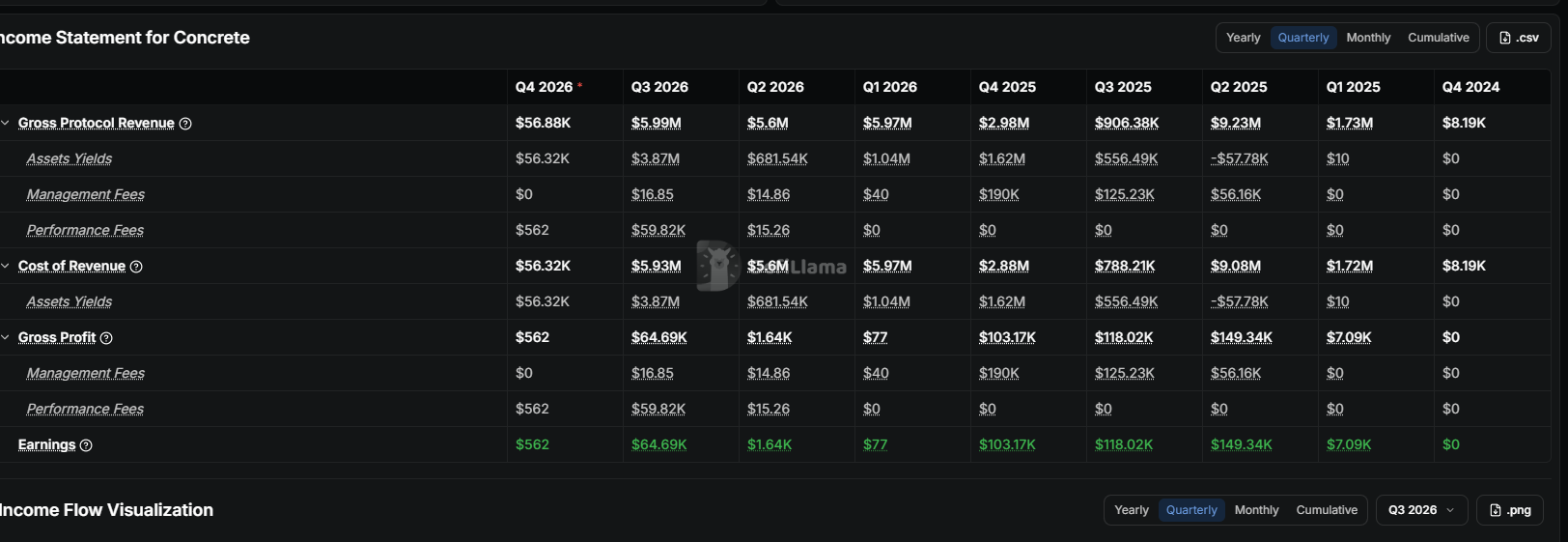
Data from the Concrete Foundation dashboard and DefiLlama places Concrete’s deposits or TVL at approximately $1.2-1.3 billion. During the latest referenced 30-day period, the protocol generated roughly $479,000 in fees but retained only around $25,300 in revenue.
These figures are not necessarily contradictory. Project-reported deposits and DefiLlama TVL may differ because of asset coverage, update timing, and methodology. More importantly, DefiLlama’s fee figure includes vault yield, management fees, and performance fees, while revenue represents the portion retained by the protocol. Since most yield goes to depositors, the gap is understandable.
However, $25,300 in monthly revenue against more than $1 billion in TVL shows that Concrete has not yet converted its asset base into significant retained income. Enterprise and AssetCX could improve monetization, but high TVL alone will not create value for
$CT holders if most economic benefits continue flowing to depositors and partners.
Blueprint Finance raised $17 million across two rounds in 2024 and 2025. In August 2026, it announced another strategic round led by Polychain, with participation from BitGo, FalconX, and Keyrock. These investors may strengthen Concrete's custody, liquidity, and distribution network, but they do not guarantee CT’s performance.
Concrete's closest competitors are not necessarily Aave or Morpho, since it can deploy capital into those lending markets. Veda and Lagoon are more direct comparisons because they also provide vault infrastructure. Unlike Ethena’s synthetic-dollar model or Pendle’s yield marketplace, Concrete aims to serve as the underlying infrastructure connecting multiple products and strategies.
This positioning reduces dependence on a single source of APY and expands access to institutional clients. However, every strategy, custodian, oracle, bridge, and third-party protocol adds another dependency. Audits by Halborn, Cantina, Zellic, and Code4rena are positive, but they cannot eliminate economic, operational, or integration risks.
5. CT's Potential, Valuation, and Key Risks
At a reference price of approximately $0.40 following the TGE, CT's fixed supply of 1 billion tokens implies a theoretical fully diluted valuation of around $400 million. This is not the circulating market capitalization. While the circulating supply remains unclear, FDV, the unlock schedule, and real market liquidity are more informative than a market-cap figure that may be based on incomplete data.
Annualizing Concrete's 30-day revenue produces a figure of approximately $304,000, placing the FDV-to-revenue ratio above 1,300. This should not be treated like a stock-market P/E ratio, because CT is not equity and does not give holders a claim on revenue. However, the comparison demonstrates that the market is pricing CT around future growth and its potential role as infrastructure, rather than current cash flow.
The bullish case for Concrete is relatively clear. The project had a functioning product and meaningful scale before launching a token; demand for integrated yield infrastructure is growing; AssetCX creates a rare bridge between qualified custody and DeFi; and
$CT could become more useful as governance, fee configuration, and additional modules move on-chain.
If tokenized assets and on-chain finance continue to expand, institutions will need more than another farming interface. They will need accounting infrastructure, permission controls, custody integrations, and risk-management systems. This is the market Concrete is targeting.
That said, five major risks deserve close attention:
Value accrual: CT does not provide dividends or a revenue claim. Long-term demand must come from governance and staking benefits, neither of which has been fully proven.
Supply concentration: The team and investors control 50% of supply, with another 15% allocated to the Foundation. Vesting only delays potential selling pressure.
Governance transition: The multisig remains important. If the shift toward timelocks and on-chain voting is slow, CT's governance value will remain more theoretical than practical.
Vault risk: Strategies can lose money, smart contracts can fail, withdrawal queues can become delayed, and bridges or custodians may experience incidents. Concrete also acknowledges risks such as slippage, impermanent loss, and reliance on third parties.
Valuation and liquidity: CT has only recently completed its TGE, circulating supply remains unsettled, and derivatives markets may amplify price volatility.
Rather than focusing only on CT's price, investors should monitor TVL after adjusting for changes in asset prices, the share of deposits coming from institutions, protocol revenue and fee take rate, the number of modules that genuinely require users to stake or lock CT, the unlock schedule, whale concentration, and the transition from multisig control to token-governed timelocks.
If TVL grows while revenue, user activity, and staking demand remain flat, the token thesis will weaken. Conversely, if Enterprise and AssetCX create sustainable revenue while CT develops real utility across the ecosystem, the token's valuation would have a stronger foundation.
6. Trading CT on MEXC
$CT was
listed on MEXC in the Innovation Zone on September 30, 2026. The exchange supports CT spot trading against USDT and USDC and also offers CTUSDT perpetual futures with leverage of up to 20x. Users can fund their Spot accounts with USDT or USDC, select the relevant CT trading pair, and place either a Market or Limit order. Since CT only recently completed its TGE, liquidity and price action may remain highly volatile. Leveraged futures should therefore be used only by traders who fully understand liquidation risk and disciplined position sizing.
7.Conclusion
Concrete launched CT only after its infrastructure reached meaningful scale. ERC-4626 vaults, Enterprise, and AssetCX now form a coherent suite for institutional on-chain finance.
However, a strong protocol does not guarantee CT will appreciate. Revenue remains limited, holders have no direct claim on cash flow, the team and investors control 50% of supply, and governance is still transitioning toward decentralization.
Concrete is demonstrating product-market fit, while CT remains a bet on whether its infrastructure can create lasting demand for governance and configuration rights. The key variable is whether a strong product can translate into sustainable token value.
Disclaimer: This content is provided for informational and educational purposes only and does not constitute investment, financial, legal, or tax advice. The cryptocurrency market is highly volatile. Always conduct your own research and only invest capital you can afford to lose.